



China helps Indonesia restore its coral reefs









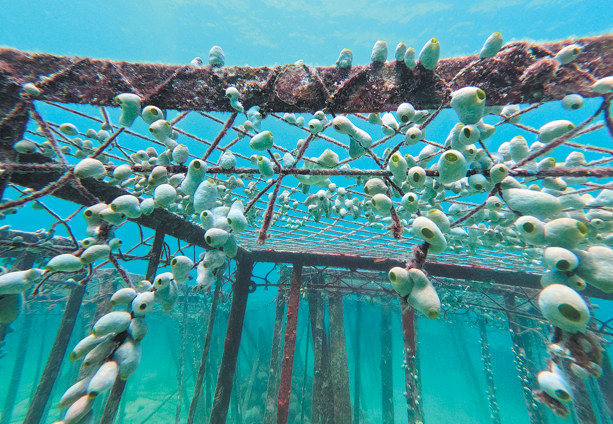
The China-Indonesia cooperative research on marine offshore ecological ranching technology project has seen remarkable progress in marine ecosystem restoration and demonstrates both nations' commitment to promoting sustainable ocean development.
The project was launched by Shanghai Ocean University in partnership with Indonesian institutions.
Liu Bilin, a researcher from Shanghai Ocean University, noted that their latest survey shows that the artificial reefs constructed in the marine ranch have evolved into a vibrant "underwater paradise".
Coral reefs are often regarded as the "tropical rainforests of the ocean" and play a vital role in marine ecosystems as they provide habitats, breeding grounds and shelter for countless marine species.
Since the project launched its first phase from 2022 to 2024, the Shanghai university has been working closely with partners, including Guangdong Ocean University in China and Indonesia's Hasanuddin University, to advance key technologies in coral restoration zoning, optimization of coral and stocked species, coral transplantation, and stock enhancement and conservation.
These efforts have helped create new homes for marine life in the waters off Pulau Bonetambung, an island near Makassar in Indonesia's South Sulawesi province.
The team's monitoring data shows that coral coverage in this area increased by 10 percent by October 2025, and surged to 22 percent by December.
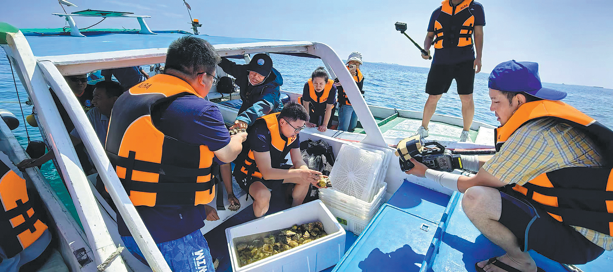
"We have identified 132 coral species, primarily Acropora and Porites genera, distributed across the marine ranch and nearby waters. The steady rise in coral coverage reflects an improving marine environment, making the marine ranch a favorable paradise for coral larvae growth and reproduction," explained Zhang Shuo, a professor at Shanghai Ocean University.
What excites the team even more is the recovery of the entire marine ecosystem. Liu pointed out that their surveys show that high-trophic-level fish such as the eight-banded butterflyfish, or Chaetodon octofasciatus, and bicolor parrotfish, or Cetoscarus bicolor, have become residents at the marine ranch.
It signals that the artificially built habitat not only offers a safe environment, but also sustains a complete food chain capable of supporting more complex marine life. A self-sustaining, dynamic coral reef ecosystem is beginning to take shape at the marine ranch.
The project is now in its second phase, running from 2025 to 2027, during which upgrades are expected in both technical approaches and management models.
To protect the corals at the marine ranch more intelligently, the project team has deployed underwater binocular cameras as tireless "ecological sentinels". These devices overcome the limitations of traditional marine surveys by enabling real-time, precise and intelligent monitoring of the artificial reef environment.
"We've installed the equipment at key sites at the marine ranch. It continuously captures high-definition images without the need for frequent manual voyages, documenting real-time changes in fish activity, fouling organism growth and biological distribution. It solves the lag and fragmentation issues of traditional methods," said Zou Leilei, a professor at Shanghai Ocean University.
Looking ahead, the project is also expanding from a single marine ranch demonstration site to wider adoption in Indonesia. Syiah Kuala University, another Indonesian institution with strong marine science expertise, has now joined the collaboration. Training courses and joint research programs will also be strengthened to cultivate more local talent in Indonesia.
wangxin2@chinadaily.com.cn


- China sets global benchmark in nature conservation: IUCN official
- KMT Vice-Chairman Chang Jung-kung to attend Straits Forum
- British woman in Hainan finds safety to be 'not just protection, but freedom'
- National college entrance exam concludes in parts of China
- China has key role in intl fisheries governance
- Family businesses thrive outside the box





