



China cracks the code for manufacturing high-performance carbon fiber









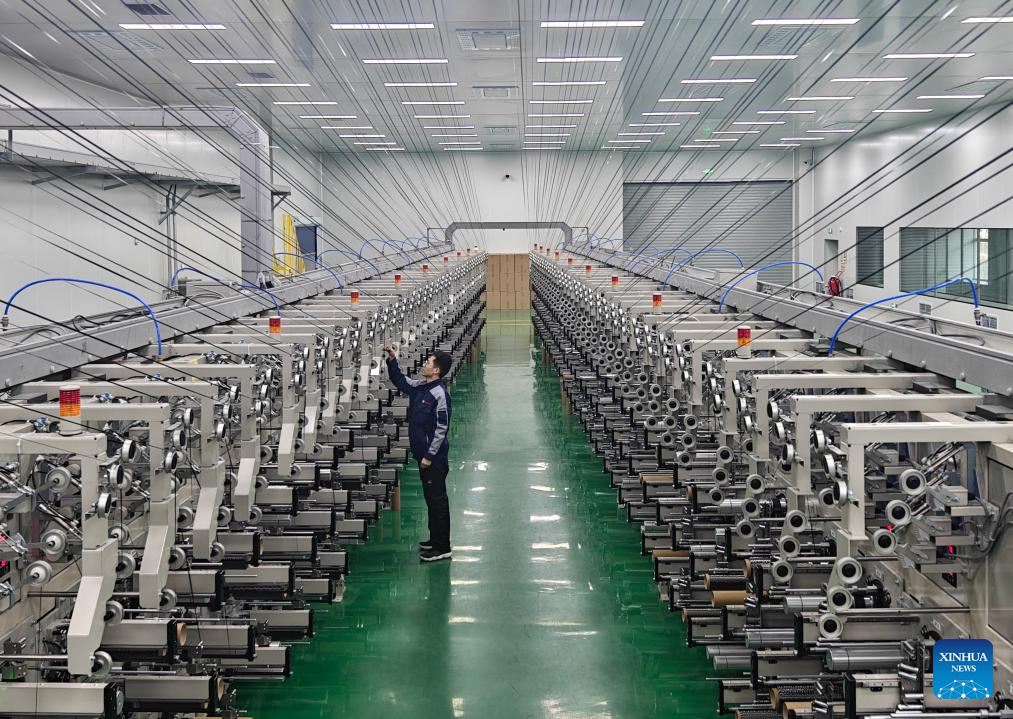
TAIYUAN -- In North China's Shanxi, a province rich in coal, the black rock once simply burned for energy is now reborn through advanced science and technology as slender yet remarkably strong carbon fiber that becomes vital parts of rockets and spacecraft soaring into space.
A high-performance carbon fiber project has recently come on stream in the province's Datong city, marking China's first domestic large-scale production of T1000-grade carbon fiber and signaling a decisive breakthrough in the country's ability to mass-produce this highest-tier material.
Jing Deqi, a senior engineer at the Institute of Coal Chemistry (ICC) under the Chinese Academy of Sciences in Shanxi, explained that the carbon fiber produced through this project has a single filament diameter of just 5 to 6 micrometers -- less than one-tenth the width of a human hair -- yet delivers a tensile strength exceeding 6,600 MPa. With a density only one-quarter that of steel, its strength is more than five times greater. For example, a one-meter bundle of T1000 grade carbon fiber weighs barely 0.5 grams yet can support a load of more than 200 kilograms, roughly equal to the combined weight of three adult men.
Carbon fiber is a high-performance material that contains more than 90 percent carbon. It inherits the intrinsic merits of carbon, such as light weight, high strength, and resistance to corrosion and heat, while remaining as flexible and processable as textile yarn. These qualities have earned it the reputation of being the "king of modern materials," making it a crucial material for industries such as aerospace, new energy vehicles, high-end equipment, sports goods and medical devices.
On a grand scale, it can be used to manufacture heat-resistant outer shells for rockets and spacecraft, form lightweight yet robust fuselages for aircraft, and construct sturdy driver cabins for top-tier sports cars.
On a smaller scale, it transforms into the carbon plates in marathon running shoes that provide powerful propulsion, becomes the lightweight and resilient fishing rods in anglers' hands, and can be used to make road bicycles so light that they can be carried up the stairs with one hand.
Furthermore, carbon fiber is indispensable for the giant blades of wind turbines, the streamlined noses of high-speed trains and storage tanks for hydrogen fuel cell-powered vehicles.
Previously, this material, often called "black gold," was controlled almost entirely by the United States and Japanese firms, who held more than 90 percent of the global high-end market.
The ICC pioneered carbon fiber research in China as early as the 1960s and 1970s. However, at that time, while high-performance sample filaments could be produced in the laboratory, the hurdle of mass production remained persistently difficult to overcome.
In 2005, the institute was entrusted with a national mission to develop aerospace-grade T300-grade carbon fiber and build an industrial line. The "T" comes from the strength grading system of the Japanese company, Toray, representing tensile strength. A higher number indicates better performance and exponentially greater manufacturing difficulty.
Driven by strong national policy support and burgeoning market demand, China's carbon fiber industry has achieved leapfrog development through sustained independent innovation. Breakthroughs and large-scale production were successively realized for T700 and T800-grade carbon fibers, with the domestic production ratio continuously rising.
At present, T1000-grade represents the frontier of ultra-high-strength carbon fiber. To master its production, Zhang Shouchun, deputy director of the ICC, led a team in their lab through years of painstaking work, finally cracking the code for the entire lab-scale process and laying a solid technical foundation for mass-production of T1000-grade carbon fiber.
"Every step was like feeling for stones while crossing a river," Zhang said. "Though arduous, we must stride forward."
In 2024, the institute collaborated with Huayang Carbon Material Technology Co., Ltd. to commence construction of the first phase of the demonstration production line for a thousand-ton-level high-performance carbon fiber project in Datong. Moving from lab to factory through a fully indigenous chain of innovation, the team achieved seamless, high-efficiency translation of research into product.
Zhang recalled that maintaining stability during production was grueling. When certain parameters wavered during commissioning, he and his colleagues shuttled more than ten times a day among different workshops, checking every piece of equipment. Some workshops were hotter than 40 degrees Celsius, others as cold as 5 degrees Celsius. After more than a month of such intense effort, they finally solved the problems.
He revealed that the project adopts a self-developed technological route, with the product's average tensile strength exceeding 6600 MPa, surpassing comparable foreign products and delivering stronger application performance. This achievement places Chinese carbon fiber firmly among the world's top tier in terms of technical capability.
As of November 2025, this production line had completed continuous operation verification. The first phase has achieved an annual production capacity of approximately 200 tonnes.
Zhang noted that China's achievement in technological breakthroughs and stable production of high-performance carbon fiber means achieving self-sufficiency in many critical fields. It will powerfully drive the development of the industrial chains and foster emerging industries.
The products will see extensive future applications in aerospace, rail transportation, new energy vehicles and the low-altitude economy, injecting strong momentum into the high-end, intelligent and green transformation of China's manufacturing industry in the country's 15th Five-Year Plan period (2026-2030), Zhang added.
Looking ahead, Zhang said the team will continue striving for even higher grades of carbon fiber and transform more technological achievements into mature products to meet the increasingly diverse needs of every sector.


- Beijing's robot 4S store showcases embodied AI in action
- Wuxi's newest cultural hub MLAND debuts with a symphony of experiences
- Beijing's Haidian district showcases heritage, innovation at mayors dialogue
- Dalian sends near-16,000-ton crane shipment on single vessel
- Former Zhejiang vice-governor prosecuted for bribery
- Smart conservation: Ancient trees get digital IDs





