



Pristine reservoir in Hunan shimmers as beacon of ecological action









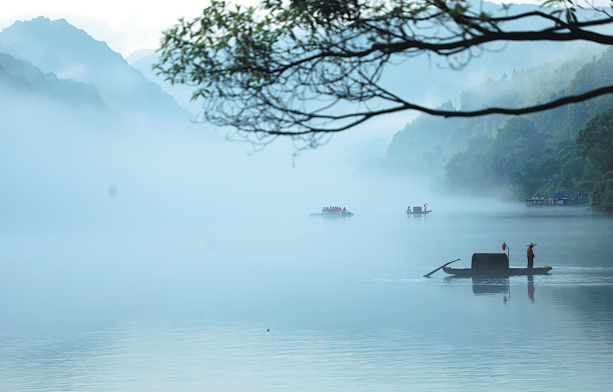
On the mist-shrouded waters of Dongjiang Lake in Central China's Hunan province, each sunrise unveils a scene of timeless beauty. A fisherman casts his net with practiced grace, its arc shimmering momentarily in the soft light before disappearing into the water. This captivating scene has become emblematic of the Dongjiang Lake scenic area.
The fisherman, Xie Yiting, has been performing this daily ritual for over a decade. Yet, there is no catch — his work is a net-casting performance for tourists who gather by the lakeside.
From April to October, the peak travel season, performers like Xie may repeat this casting over 80 times each morning. During the bustling summer months, the area welcomes more than 10,000 visitors daily, according to the scenic area's management. The countless videos and photos shared online have turned these performers — many of whom were traditional fishermen — into local celebrities.
This transformation from a practice of sustenance to a symbol of sustainable beauty mirrors the broader story of the region's commitment to protecting its precious water resources while fostering green economies.
Located in Zixing, a county-level city under Chenzhou, Dongjiang Lake is an artificial reservoir that emerged in 1986 after a dam was built on the upper reaches of the Leishui River, a primary tributary of the Xiang River.
In the 1990s, locals began fish farming in the lake using thousands of fishing nets and cages. This brought considerable income but at a significant environmental cost.
"To raise fish, we dumped enormous amounts of feed into the water," said Xie Zhilin, who started cage fish farming in the lake in 2006.
Over time, the concentration of organic waste began to threaten the water quality. Other economic activities in the surrounding areas, including mining and livestock breeding, also posed threats to the ecological balance of the Dongjiang Lake region.
In response, the local government enacted comprehensive measures starting in 2019 to restore the lake's health. More than 10 mining zones were closed, 420,000 square meters of fish cages were dismantled, 830 fishing vessels were removed, and about 600 large-scale livestock and poultry farms along the lake and river shores ceased operations.
Many locals, like Xie, who previously raised fish in the lake, shifted their fish farms to the shore.
With local government assistance, Xie founded a land-based, industrial aquaculture company, employing a water-recirculating fish farming system. Last year, his company produced over 500 metric tons of fish, generating a profit of more than 1 million yuan ($143,200), according to local media.
With the joint efforts of the government and residents, the ecosystem of the Dongjiang Lake region has significantly improved. For 10 of the past 13 years, the lake's water quality has met the national Class I standard — the country's highest benchmark for surface water. This classification signifies that the water body is in a natural state, with minimal human impact, making it an ideal drinking water source.
Besides providing high-quality drinking water, the crystal-clear lake has become the region's most valuable asset, fueling its eco-tourism sector. The lake area, featuring a national 5A scenic area, a national wetland park and a national forest park, has seen visitor numbers soar in recent years.
According to the Zixing government, in the first half of 2025, the city welcomed more than 7.6 million tourist visits, generating tourism revenue of over 8 billion yuan.
The protection of the water source has also spurred the growth of another "golden" industry: the Dongjiang Lake orange.
By late autumn, the hillsides around Qingjiang township in Zixing are heavy with fruit. About 1,300 hectares of orange groves have transformed the local economy, contributing the largest share of the township's agricultural output and boosting the average annual household income, local authorities said.
This agricultural success is deeply rooted in the unique microclimate created by Dongjiang Lake.
The water acts as a natural thermal regulator, absorbing heat in summer and releasing warmth in winter. This creates a humid, fog-frequented environment with a significantly reduced frost period along the shores — a perfect natural greenhouse for citrus cultivation.
Across the wider Dongjiang Lake region, more than 8,600 hectares of land are dedicated to citrus farming. In 2015, the Dongjiang Lake honey orange was recognized as a national geographical indication product. Its reputation now extends beyond borders, attracting buyers from across China during the harvest season and reaching international markets in Russia and Southeast Asia.
Contact the writers at limuyun@chinadaily.com.cn


- China's State Council sets up team to investigate Shanxi coal mine explosion
- Desert fighter, US friend to reunite soon
- Serbian president meets HBIS chief, backs green steel push in Belgrade
- Chinese-built cruise ship passes sea trials
- Senior Jiangxi official Li Wei investigated for discipline violations
- Guangzhou launches latest affordable housing scheme





