



Scientists synthesize single-crystal sp² carbon-linked covalent organic frameworks









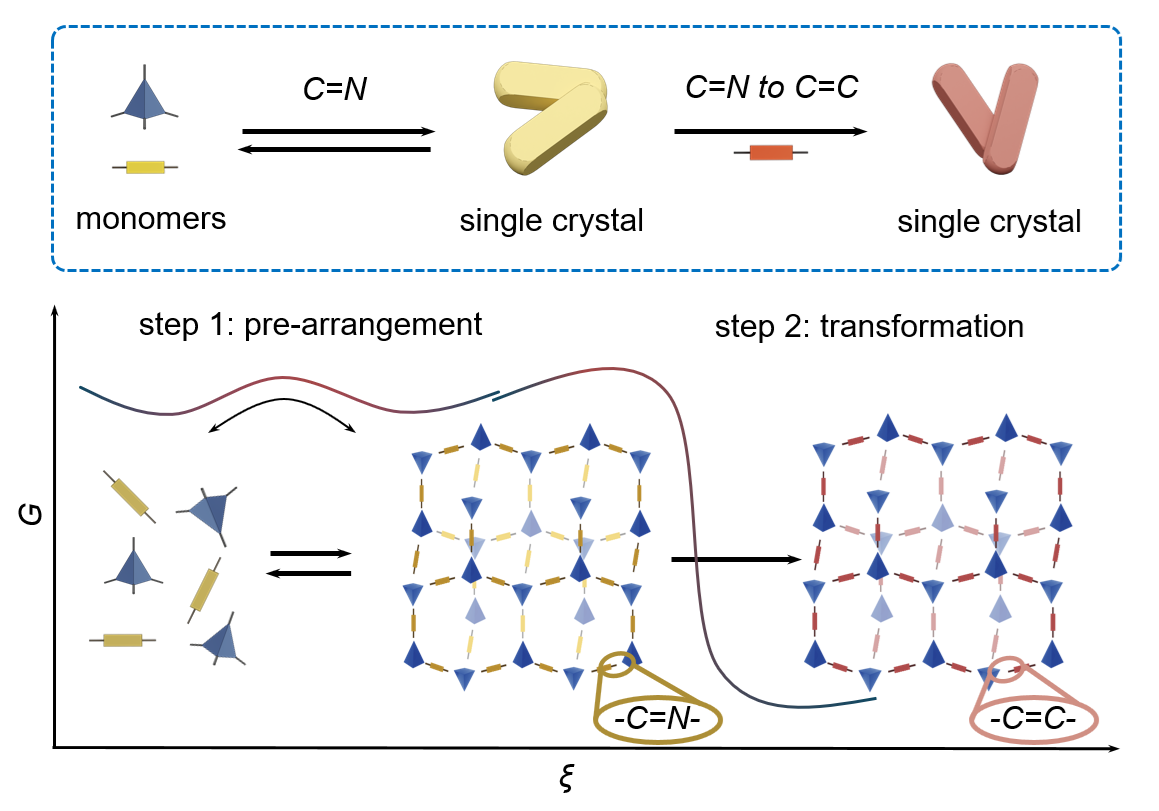
Chinese scientists proposed a novel imine-to-olefin transformation strategy to synthesize single-crystal sp² carbon-linked covalent organic frameworks (sp²c-COFs).
COFs are crystalline, porous polymers constructed by organic molecules through strong covalent bonds. COFs have numerous applications, including gas storage and separation, sensing, drug delivery and biomedical applications, organic electronics and photonics, etc.
Sp²c-COFs are a special type of COF that integrates sp² carbons, attracting great attention in organic semiconductors. The robust C=C bonds endow the sp²c-COFs with enhanced electronic conductivity, optical activity, and magnetic properties in comparison to classical C=N linked COFs.
Highly ordered single-crystal sp²c-COFs play indispensable roles in delving into the molecular structures, fundamental properties, and device application performance of sp²c-COFs. However, the low reversibility of olefin bonds impedes crystal self-correction, thus generating only polycrystalline or amorphous compounds instead of single crystals.
In the study published in Nature Chemistry, a research group led by Prof ZHANG Tao at the Ningbo Institute of Materials Technology and Engineering (NIMTE) of the Chinese Academy of Sciences (CAS), in collaboration with Prof Zhang Zhenjie at Nankai University, synthesized single-crystal sp²c-COFs through an imine-to-olefin transformation strategy.
The structures of the single crystals were characterized using high-resolution transmission electron microscopy (HR-TEM) and continuous rotation electron diffraction (cRED).
The efficient transformation from imine to olefin linkage enhances the π-conjugation in sp²c-COFs, facilitating extensive electronic delocalization. Compared to samples with C=N linkages, the synthesized single-crystal sp²c-COFs exhibit significantly enhanced electron spin, leading to notable room-temperature, metal-free ferromagnetism of 8.6 × 10⁻³ emu g⁻¹.
Two high-quality single-crystal sp²c-COFs have been developed, demonstrating the generality of this approach. This work addresses the bottleneck in synthesizing single-crystal COFs and provides insight into the future development of organic semiconductor applications.
The study was funded by the National Natural Science Foundation of China (No 52322316), the Zhejiang Provincial Natural Science Foundation of China (No LR21E030001), and the Key Research and Development Program of Ningbo (No 2022ZDYF020023).





