Shuozhou's history resonates, beckoning tourists of today
By Zhao Bian ( China Daily )
Updated: 2010-09-24
|
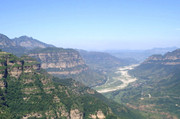
Aerial view of Shuozhou. Photos Provided To China Daily |


A land of ancient civilization and a stage for battles and integration through its long history, Shuozhou is now among the favored tourism destinations in Shanxi province.
Located on the east of the massive Loess Plateau, Shuozhou has a varied topography, with numerous mountains and streams, and a mild climate with four distinct seasons.
Archeological excavations revealed that as far back as 28,000 years ago humans lived in the area.
Two millennia ago, General Meng Kuo of the Qin Dynasty (221-207 BC) ordered a town built on the site called Mayi. It became a prefecture during the Northern Qi Dynasty (AD 550-577), which it remained until the early days of the Republic of China (1912-1949).
The beautiful Sanggan River is the largest river in Shuozhou. It drains an area of 7,690 square kilometers and eventually flows to Beijing.
The river has played an important role in Chinese civilization, earning the title "Mother River".
A literary masterpiece by Ding Ling in the 1950s titled Sun Shining On the Sanggan River made the waterway well known both at home and abroad. Today the wetlands of Sanggan are listed among the first group of provincial-level wetland scenic zones.
After the founding of the People's Republic of China in 1949, the city became part of Shanxi province. It now covers 10,700 square kilometers and has a population of 1.55 million people.
History has left Shuozhou with an abundance of cultural heritage that offers unique tourist resources.
The Zhiyu Ancient Ruins dating back 28,000 years was the home of Shuozhou's earliest civilization in the Stone Age.
Those early inhabitants primarily lived by hunting animals on the prairie and came to be known as the Horse Hunting People.
War and peace
Shuozhou means "land of the north" in ancient Chinese. As the name suggests, the area was the site of numerous frontier battles, then integration, among ancient tribes.
According to historical records, before the Spring and Autumn Period (770-476 BC), Shuozhou was inhabited by peoples distinct from the majority Han.
In the Warring States Period (475-221 BC), King Wuling of the Zhao State - comprised mostly of Han people - initiated a campaign to learn the tactics of the northern tribes by riding horses in battle.
It immediately improved the mobility of Zhao military forces, making it one of the seven powerful states in the country.
In Shuozhou, it meant a rapid integration of northern nomadic tribes with the agrarian Han people, although the process included ongoing warfare.
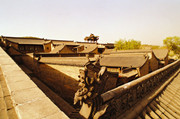
Sites of ancient wars include the famous town Liao, which served as military defense works during the Ming Dynasty (1368-1644), as well as a cemetery for billeted soldiers from the Han Dynasty (202 BC-220 AD) and the Guangwu section of the Great Wall.
The most famous of the sites is likely Jinshatan battlefield, where General Yang Jiye of the Song Dynasty (960-1279) died in a battle against the Liao Dynasty (916-1125) from the north.
General Yang was among the fierce warriors trying to save the economically prosperous but fragile Song Dynasty.
He and six of his seven sons were killed in wars, leaving behind widows who continued to lead the army into battle.
"The Female Generals of Yang's Family" is still a popular topic of many novels, ballads and operas.
When the wars finally ended, Shuozhou became a boomtown for trade and cultural exchanges among the various ethnic groups.
There was also enough leisure time for people to enjoy poems by Ban Jieyu - a Shuozhou native and China's first female poet - as well as many frontier poems written by those who lived and battled there.
While the wars were transient, the blending of agrarian Han and northern nomadic peoples eventually brought peace to Shuozhou.
Harmony and peace were common ideals, as shown by the ballad that says "there is a land in north China called Shuozhou, a place of peace and harmony".
Buddhist culture
In addition to the many cultures in the area, Shuozhou also welcomed then-exotic notions from India - Buddhism, which took root some 1,500 years ago.
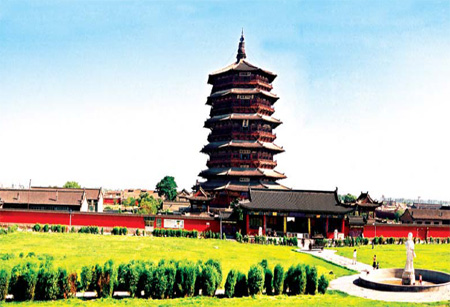
Today ancient Buddhist architecture is a valuable treasure of Shuozhou. The city boasts the oldest and tallest wooden pagoda in the world - Shijia Pagoda in Yingxian county.
Ranking among the three most extraordinary towers in the world, it was built entirely of wood nearly 1,000 years ago during the Liao Dynasty.
The dovetailed structure made without a single nail is still well preserved today.
In the last half of the 20th century, two pieces of bone relic said to be from the Buddha himself were discovered in the pagoda, making it a holy site for Buddhists.
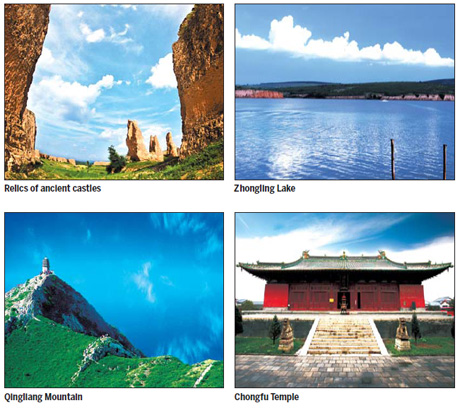
In addition to the Wooden Pagoda, Shuozhou also has many other Buddhist heritage sites including the Chongfu Monastery and Qingliang Monastery.
|
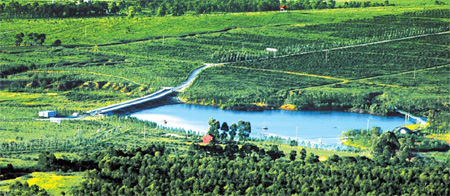
Improving ecology in north China. |
|
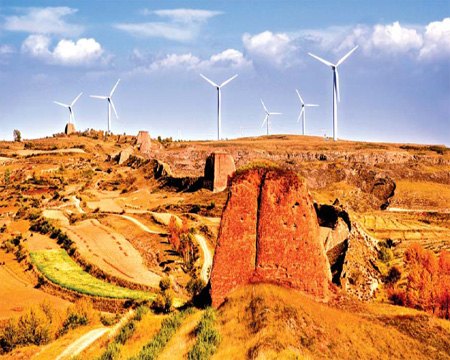
Wind power plants near the city. |
|
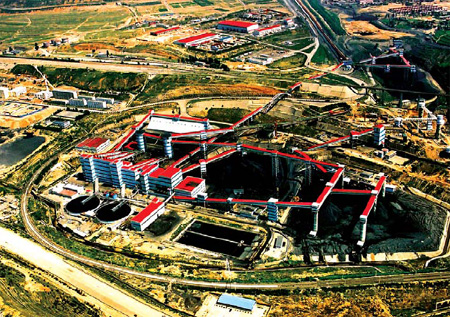
Coal washing facilities in Shuozhou. |
|
Shijia Pagoda in Yingxian county |
(China Daily 09/24/2010 page6)