|
 |
|
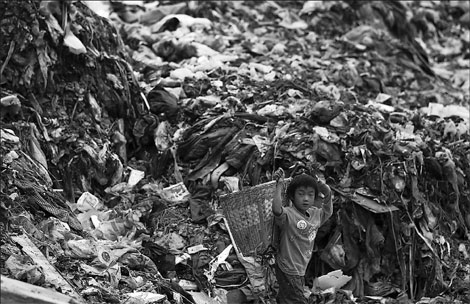
Jiao Qiang, 10, collects garbage after school at Gaoyan Landfill in Guiyang, Guizhou province, to help his parents. Photos by Wang Jing / China Daily
|
 |
|
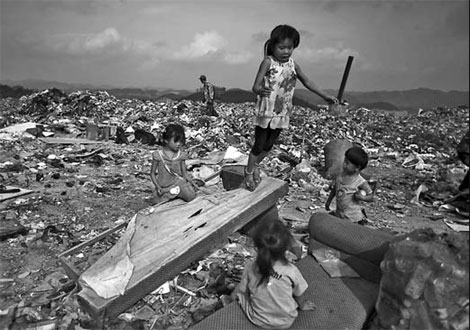
Children from the garbage collectors' families find their playground at the landfill.
|
 |
|
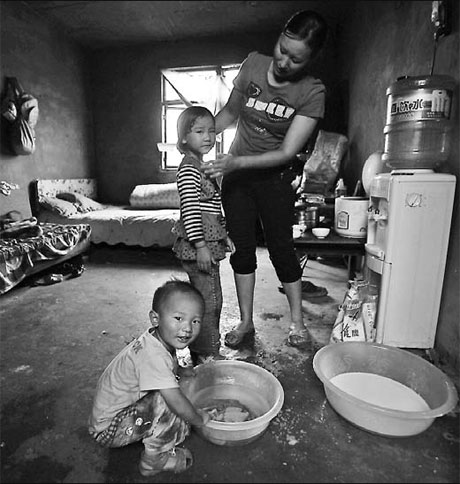
Yang Zhenjia, 3, and his sister, change into clean clothes and wash up with the help of their mother after returning from the landfill.
|
Gaoyan Landfill in Guiyang provides poor pickings for about 300 people who live near the site and make a meager income from what others throw away. Xu Lin reports.
Dressed in tattered clothes, 10-year-old Wu Min uses a knife to open the wrappers of sausages that have been thrown away after their expiration date. She pays no attention to the grubs wriggling at her feet.
This is a common scene at Gaoyan Landfill in Guiyang, capital of Guizhou province. The tip has dozens of slopes composed of the 1,700 tons of household garbage that are delivered daily by garbage trucks.
About 300 people live near the landfill and make a meager living by collecting rubbish. Mothers carry their babies on their backs as they pick through the trash, while toddlers play. After school, more children arrive to help their parents.
China has about 6 million garbage collectors. Since the 1980s, migrant farmers have been flowing into cities for jobs, and find collecting trash is the only option they have due to their lack of education. It's a dirty, tiring and unrewarding job, which is viewed by most people as the lowest of the low.
"It's a hand-to-mouth way of life, but we are accustomed to the dirt and smell," says Gao Zhengqin, 33, who smashes glass bottles and puts the fragments into a big bag.
Her family of six lives in a 20-square-meter room and pays more than 200 yuan ($31.38) a month for rent, plus water and electricity charges. Gao and her husband each earn 600 yuan per month.
Work is from 4 am to 8 am, and 5:30 pm to 1 am, because that's the only time they are allowed to gather trash in the landfill. After making their haul, they sort the trash into categories, such as glass, plastic and leftovers.
Gao then loads up her secondhand tricycle, worth 1,000 yuan, and drives to the yard where the trash is collected and she is paid. Glass fragments are worth about 0.02 yuan per kilogram and plastic is 1.2 yuan per kilogram.
"I've never found anything precious but occasionally I find useful things, such as clothes, shoes, toys and food," Gao says.
"It's difficult to make ends meet in my hometown. My life is tough now, but it's better than it used to be," she says.
Gao and her husband were farmers in Zhijin county, about 157 km from Guiyang. In 2007, driven by years of drought and scarcity, they moved to find a job and ended up collecting trash.
Wu Xiaojun, from the Miao ethnic group, is from Guiyang and moved to the landfill in February when he was laid off from a drill factory.
"It's difficult to find a job, even manual labor. People living here are all poor, farmers or laid-off workers like me, and many are from ethnic groups," the 32-year-old says.
He locks his kids inside the house when he and his wife go to the landfill.
"It's risky for kids as there are so many cars. And I don't need my children to help me collect rubbish," Wu says.
Wu is an exception to the rule. Gao's eldest kid, Liao Shengfu, 13, often helps her after class, sometimes working until midnight.
"We eat pickles, kidney beans and rice at home and have meat once every couple of months. I will drink more bean soup if I'm still hungry," he says.
Liao says some kids eat food found in the landfill, but his mother forbids him to do so. His three younger sisters and brothers stay at home and do their homework.
"I like to help my mom, but I don't want my classmates to know what my family does," Liao says.
Dealing with trash every day, hygiene is essential. Gao always takes a shower when she returns home, changing out of her "landfill uniform" into clean clothes. As there is no public bathhouse, they boil water and shower in their only room. Liao does the same.
"We are all in good health, and I can't blame anyone else if we are struck by disease, as I'm doing this kind of job," Gao says. "We haven't enough money to see a doctor and instead buy cheap medicines when we have to."
She can't get government assistance because her hukou (residency permit) is not in Guiyang.
Huang Meng, from Guizhou province's Department of Civil Affairs, says if she did have a hukou she could apply for dibao, or minimum living standard assistance.
"The government provides temporary assistance to poor families who have an accident, such as serious disease or death. But this is also based on the hukou system," he says.
Even so, there is hope.
"I feel comfortable here, as I don't have to take orders from anyone," says Peng Zhongyong, 22, who was born and raised in landfills.
Peng went to Guangdong province to work in a handbag factory and had a monthly salary of 1,000 to 2,000 yuan. But he returned a year ago.
"I never regret that I quit school because I didn't like it. It's normal for a kid to help Mom, even if it's to gather rubbish," he says.
"I'm not rich. But It's OK because however rich one is, one is never satisfied with one's life."
|