
A bar of no alcohol
Updated: 2006-10-19 11:44
One of the most important nine held during the Qing Dynasty (1644D1911)-was the Huguosi Temple Fair on the eighth day of every month on the lunar calendar. From this tradition, Huguosi (Huguo Temple) snacks emerged more than 300 years ago.
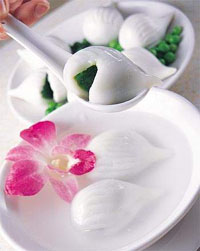 Though the Huguosi Temple Fair has not survived the passage of time, the great variety of traditional Beijing snacks has been handed down generation by generation. Most Huguosi snacks are visually appealing and sweet. They are regarded as representative of Beijing snacks. In 1956, the Beijing Municipal Government founded the Huguosi Snack Bar, and invited at least ten Beijing traditional snacks makers to work there. From a small snack store, it developed into one of Beijing's largest chain-store operations with nine branches producing traditional Beijing snacks.
Locals living around the nine branch stores have always been their major customers, and in this regard, nothing has changed. Many of them arrive early of a morning and order a few snacks and a soup. Ms. Li, the production manager of Huguosi Snack Bar, now managed by the Beijing-based Ju De Hua Tian Group, said, "Unlike in the past, more customers now come at noon or in the evening. They may not bother to cook at home." Another big change is that the number of young customers is increasing, which is somewhat unusual because in the past Beijing snacks were more popular among the elderly than among the young.
"We conduct research and learn from others so we can make improvements in our snacks' flavours, colours and shapes, as we do with our food containers. For example, people now are inclined to eat foods with smaller amounts of sugar, so we try to add less sugar in all the sweet snacks. Another example is that we experiment a lot to ensure that the colours of the foods are tempting. Of course, we use no chemical additives.
"The snack bar offers more than 80 kinds of snacks. When festivals come, we add 20 special snacks such as yuanxiao (sweet dumplings made of sticky rice, usually eaten during the Lantern Festival) with different fillings. In general, at a Huguosi Snack Bar, 5 yuan or 6 yuan is enough for one person's lunch or dinner."
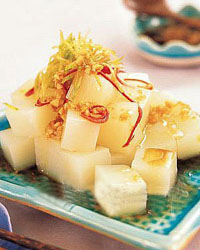 The snack bar has created two special feasts or banquet servings that feature different kinds of snacks. Priced at 400 yuan (US$50) and 500 yuan (US$63), the first feast features 10 kinds of snacks, while the second has 18 with such favourites as sticky rice cake and bean jelly. These two feasts have set menus. However, if a special kind of snack is required, it can be used to replace another snack on the menu.
The Huguosi Snack Bar knows its clientele very well and is very sensitive to their special needs. For instance, ethnic Hui Muslims never eat pork. Any meats they consume should be prepared by a special group of people from within their own ethnic group to ensure that they are clean, unpolluted and suitable for Hui consumption. The Huguosi Snack Bar has its own food suppliers to guarantee the safety and quality of its raw materials. Early each morning, special contingents of the Hui are invited to prepare the meats (mainly beef and mutton) served at Huguosi's snack bars. For this reason, many Huis prefer to eat there.
Stories and pictures illustrating Beijing snacks, many of which were enjoyed by Beijing's imperial elite, can be found at Huguosi Snack Bars. This helps customers learn more about the history of Beijing snacks, as with the famous writer Lao She who was a frequent visitor at the Huguosi Snack Bar and who wrote several pieces on Beijing snacks. According to Ms. Li, the street where the original Huguosi Snack Bar is located is likely to become a "snack-bar street."
Huguosi Snack Bar
Location: No.93 Huguosi Dajie Xicheng
Tel: 010-66181805
ClickHEREfor more Huguosi Snack Bar locations.
|
||
|
||
| Eating out:
Arriba arrives in the Wu
Bars&Cafes: Mare's milk a-go-go Weekend&Holiday: Ancient sites re-open after renovation Shopping: Jimmy Choo comes What's on: New shows on stage |
|
||
| Eating out:
Moroccan roll
Bars&Cafes: A boonna in training Weekend&Holiday: Pop power Shopping: LV boutique in E. China closed for disqualification What's on: Jazz-infused journey through Kunqu Opera |