London: A sneak preview
Updated: 2012-02-26 07:58
By Elaine Glusac (China Daily)
|
|||||||||


|
 |
|
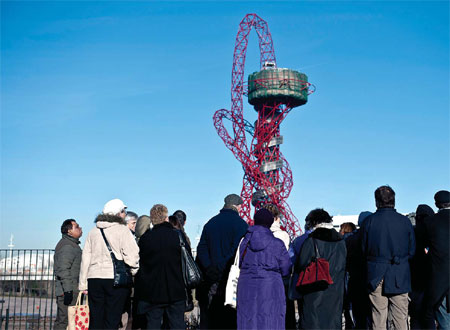
The Orbit Tower in Olympic Park is a viewing platform designed by sculptor Anish Kapoor. Photos by Elaine Glusac / for China Daily |
Starting in July, most of the Olympic buzz in Britain's capital will be at the East End, and Elaine Glusac takes a first look at what to expect.
Even on uncharacteristically sunny days, it's a lonely walk from the closest tube stop to London's forthcoming 200-hectare Olympic Park. But after reaching the 80,000-seat Olympic Stadium - skeleton in place and awaiting its exterior sheeting - I found hundreds of other construction-site rubber-neckers clogging the sidewalk. The tourist crush was seemingly what the Olympic bid committee had in mind when it proposed London's East End, about a dozen underground stops northeast of fixtures like Big Ben, as the epicenter of the competition, which begins July 27.
Though sailing races will be held in Weymouth and Portland, and soccer matches around the country, most of the games will take place in this industrial wasteland now poised for a turnaround.
But long before the Olympics came to town, the East End played a leading if shadowy role in London's history.
In past decades, few tourists may have felt compelled to visit an area known for abandoned warehouses, racial strife and Jack the Ripper's murder spree.
Now two tours reframe the area, in the first case as a shining new home for the Olympics, and in the second as a collection of vivid neighborhoods that once absorbed the worst of the bombing in World War II, gave birth to the Salvation Army, inspired George Orwell and Jack London, and now is home to a mix of striving immigrants and artists.
"The bid was predicated on a part of London that was sorely in need of help," said Steven Back, a Blue Badge guide with Tour Guides, who led me and 12 other visitors on a two-hour Olympic Walk departing from the Bromley-by-Bow tube station.
Standing before the restored 1776 House Mill, Back described the area during the years before the Industrial Revolution as "London's breadbasket," where agricultural fields banked the Lea River, and mills processed grain.
Industrialization transformed the area, introducing soap factories, leather tanneries and chemical plants that polluted the air and water but remained downwind of posh districts to the west.
Pockets of gentrification in East London predate Olympic efforts.
Shouldering a tripod, a cameraman stopped to ask directions to nearby 3 Mills Studio, the largest soundstage in London, used by the filmmakers of Never Let Me Go and Sherlock Holmes II, and currently engaged in preparing for the Games' opening and closing ceremonies.
Despite a few apartment buildings and funky houseboats lining the canals, the Olympic vicinity of East London felt empty, with construction cranes appearing to outnumber people.
That sense of desertion changed as we ascended the Greenway, a 4.4-mile (7 km) elevated footpath that follows the area's sewage system and skirts Olympic Park.
"Sometimes we get a whiff, but it smells quite good today," our guide observed.
Roughly one mile from our start, we joined other groups milling in front of the construction zone to survey the stadium, the distant stingray-shaped aquatics center designed by Zaha Hadid, and the Orbit Tower, a viewing platform designed by the sculptor Anish Kapoor.
Strolling north, we glimpsed the white cube that will host basketball games and the elliptical, wood-clad velodrome by Hopkins Architects nicknamed the "Pringle."
The tour ended at the View Tube, a neon green shipping-container-turned-community center.
Its Container Cafe, posted with local artwork and populated by lingering coffee sippers, offers the tour's only glimpse of residents in the Olympic area, a mix of scruffy artists, quiet pensioners and working-class mothers shepherding their children to an adjacent playground.
After the Games, plans include converting the stadium to a home for one of the area's professional soccer teams; the swim center to a community pool; and the athlete's village to affordable housing.
But a tour of Olympic Park reveals little about local life in East London, which is considered Britain's gateway for immigrants, with large concentrations from Bangladesh, Africa and the Caribbean.
For a more insiderly tour of the East End, I contacted the new London Greeters service.
Founded last February, London Greeters offers free, resident-led, one-on-one tours that range from one to four hours.
The organization's 22 volunteer guides cover the five East London boroughs, as well as Camden in Central London.
Arrangements require e-mailing the Greenwich-based service at least two weeks before a visit.
I expressed an interest in art, aiming for Shoreditch or Hoxton on the list of neighborhoods I would visit.
Three days later, I received what sounded like a less-than-perfect match. A man named Graham Woods was available on my designated date to show me around Hackney, a working-class area with little presence in guidebooks. But in pre-meeting e-mails, Woods enthusiastically detailed three itineraries.
We settled on a two-hour itinerary for which I was 20 minutes late. I found my tall, bearded escort, a retired engineer's model maker, patiently waiting outside the Hackney Central train station.
Hackney made a jumbled first impression.
Ethnic restaurants range from African to Vietnamese. A Greek Orthodox church is near a fashion school. A Victorian-era theater has a weedy tree growing on its roof.
A fuller picture of the area began to form in the Hackney Museum, where artifacts included a re-created World War II air raid shelter with cot and gas mask, and exhibitions that charted Jewish and Asian immigrant waves.
Afterward, crossing London Fields (a former meadow for slaughterhouse-bound livestock that is now a park with towering London plane trees), we entered a neighborhood of subsidized apartments built after World War II. As we watched a boy kicking a soccer ball on a fenced-in lawn, Woods explained that the brick row houses replaced areas bombed by Nazi pilots aiming for East End factories. His own family's home here was destroyed, he said.
"They said I flew through the window," Woods said, describing the bombing that left his family uninjured but homeless. "I was 2 years old. I don't remember."
We passed three Middle Eastern teenagers in hoodies, a bricklayer tuck-pointing an apartment bearing a "Sold" sign, and stylish couples hastening down the residential streets en route to busy Dalston Lane, where Woods took my arm to avoid careening double-decker buses as we crossed.
Now in a bohemian pocket known as Dalston, we looked in on a cafe called Farm Shop, which grows much of its own produce, raises fish in tanks surrounding the tables, and draws 20-something laptop-tappers at this between-meals hour.
We stopped to see the flower-filled Dalston Eastern Curve Garden, a community garden in an abandoned rail yard, then climbed four stories to the top of a onetime paint factory, now home to the funky Dalston Roof Park with raised herb beds and a bright turquoise shed-cum-bar serving tap beer and margaritas.
In the former factory next door, we peeked into Arcola Theater, spying on a pair of sweaty actors blocking a fight scene onstage, and an eclectic music club called Cafe Oto, where hipsters clad in retro plaid capris and muscle T's chatted over the jazz on the sound system.
Though our two-hour plan stretched into three, Woods insisted on escorting me by train to my next appointment in nearby Shoreditch.
The Olympics, I learned from my first guided exploration, has already created a new destination in the East End. But the Greeters service gives the existing place a face.
New York Times Syndicate
(China Daily 02/26/2012 page16)



Hot Topics
Wu Ying, iPad, Jeremy Lin, Valentine's Day, Real Name, Whitney Houston, Syria,Iranian issue, Sanyan tourism, Giving birth in Hong Kong, Cadmium spill, housing policy
Editor's Picks
|
|
|
|
|

|