 |
|
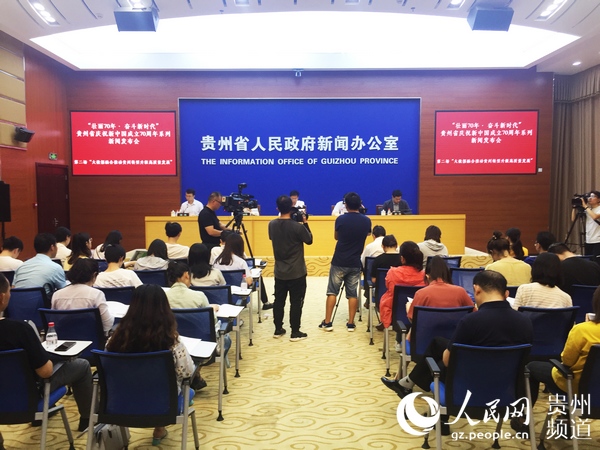
The Information Office of Guizhou Province holds a news conference in Guiyang, capital city of Guizhou province, on June 19. [Photo/people.com.cn] |
Guizhou has taken the integration of big data with the real economy as a powerful engine to promote transformation and upgrading, according to the information released during a news conference held in Guiyang on June 19.
It was reported that Guizhou has built 102 benchmarking projects and 1,050 demonstration projects, helping 1,625 enterprises integrate with big data in 2018. The big data and real economy integration index of Guizhou reached 36.9, which signify that it is developing from the primary stage to the intermediate stage.
In recent years, big data has been integrated in Guizhou’s real economy, rural revitalization, people's livelihoods, and social governance, propelling the development of the province.
The deep integration of big data with the real economy has become a new driving force for high-quality development. A large number of traditional enterprises have undergone transformation and upgrading with the help of big data. Approximately 33.9 percent of the industrial enterprises in Guizhou have integrated big data with key business aspects such as R&D, production, sales, and management. In addition, the integration index of informatization and industrialization in Guizhou has moved up 10 places in the national ranking since 2014.
The deep integration of big data with rural revitalization has also achieved great developments. All administrative villages in Guizhou have achieved full coverage of 4G networks so that modern information technology is widely used in production, management, and services in rural areas. In addition, the province has built more than 70 county-level e-commerce operation service centers and 10,250 village-level e-commerce service stations. A total of 79 cities and counties have been selected as national or provincial e-commerce demonstration points.
In addition to industrial and informational transformation and upgrading, the province also better serves its residents and improves people's livelihoods through big data. It is worth noting that Guizhou is one of the first provinces to implement remote medical treatment from hospitals at the provincial, city, county, and village levels. To date, medical bodies of the province have organized difficult disease consultations, providing remote diagnosis for 190,000 villagers, as well as holding more than 300,000 distance education training courses for over 200,000 people.
The integration of big data with social governance has made government management services more efficient. Many e-government applications provide platforms for the sharing and exchange of government information.
Since 2014, the province's value added of the electronic information manufacturing industry and the income of software services saw an annual growth rate of 35.31 percent and 30.56 percent respectively. The proportion of the electronic information industry has increased to 1.9 percent from 0.3 percent in 2013.
According to a white paper on digital economy published by the China Academy of Information and Communications Technology, Guizhou's digital economy growth has ranked first in China for four consecutive years. Big data is being widely applied in government management, business, and daily life, contributing over 20 percent to the economic growth rate of the province.
Zhao Yandi contributed to this story