



Old architectural marvel in Beijing back in public view









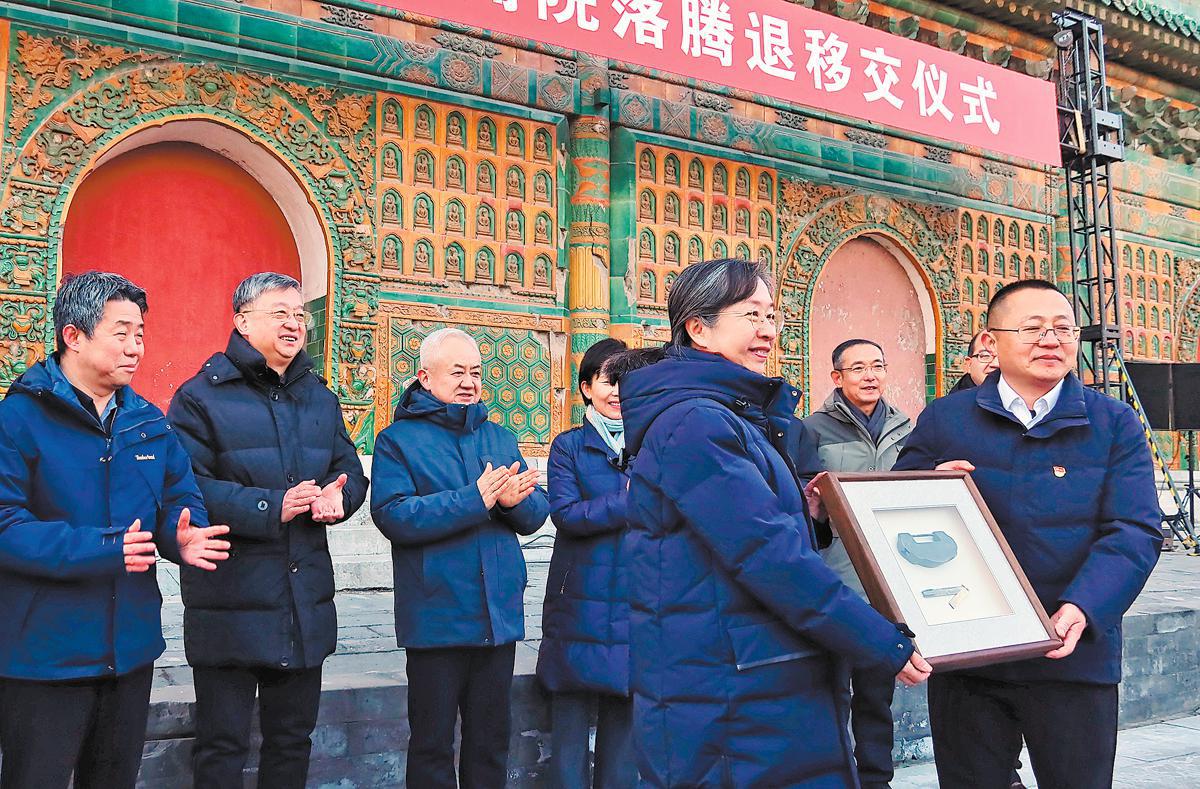
Near the northern gate of Beijing's Beihai Park, behind a sign reading "No admittance for the public", passersby have long wondered about the nature of a splendid, temple-like compound hidden from view.
Part of Beihai during the years of a royal garden, the courtyard centered on Liuli Ge, a structure more than 250 years old, has served as offices of the Beijing Institute of Archaeology and its predecessors since 1955. On Thursday, amid emotional farewells and best wishes from generations of archaeologists, the administration of the compound was transferred back to Beihai Park, a move expected to add a new landmark to the popular tourist destination in the near future.
Liuli Ge, which translates into Belvedere of Liuli, was built in 1759 during the reign of Emperor Qianlong of the Qing Dynasty (1644-1911). Liuli, finely glazed pottery in vivid colors, is commonly used to decorate high-ranking traditional Chinese architecture, particularly roofs and walls.
First-time visitors are often struck by the structure's unusual splendor. Nearly the entire building is constructed of liuli. Beneath its three-tiered eaves, 1,424 statues of Amitabha Buddha adorn its facades.
"It represents the pinnacle of liuli architecture," said Zhang Lixin, director of the Beijing Municipal Cultural Heritage Bureau.
To the south of Liuli Ge stands an octagonal pavilion built in 1777. It houses a collection of Buddhist stelae inscribed in Emperor Qianlong's own handwriting. Its complex structure, along with a roof made of liuli and gilded gold, demonstrates the exceptional engineering skills of ancient artisans, Zhang added.
Generations of archaeologists who worked at the Liuli Ge compound carefully maintained and conserved the architectural heritage site. As a result, the site appears almost unchanged from photographs taken around 1900, which were displayed at the handover ceremony, though a sapling visible in those images has since grown into a towering tree.
"After 70 years of close association with this site, we feel deeply reluctant to part with it, given the dedication and passion of generations of archaeologists," said Zhang Zhonghua, head of the Beijing Institute of Archaeology. "At the same time, we understand more profoundly that returning it to public view is both a responsible decision in the broader interest and a practical step toward revitalizing cultural relics."
The institute has relocated to the Puhuangyu area in Beijing's Fengtai district.
"It took me an entire week to pack," archaeologist Shang Heng, who worked at the site for 16 years, wrote on social media. "And the considerable cost of moving finally finds its meaning and value for society as a whole."
The handover of the Liuli Ge compound also restores the integrity of Xitian Fanjing, or the Western Heaven Buddhist Realm, a key religious architectural complex with a history of about 400 years. First formed during the Wanli era (1573-1620) of the Ming Dynasty (1368-1644), the royal art complex continued to expand and evolve, reaching its present layout after the completion of the Liuli Ge compound in the 18th century.
Another round of renovations and environmental improvements will begin to better accommodate visitors.
"Relevant service facilities will be added, and we will redesign visiting routes to present Xitian Fanjing as a complete site," said Ren Kai, deputy head of the Beihai Park administration. "Liuli Ge will be opened to the public as soon as possible."
As part of efforts linked to the 7.8-kilometer-long Beijing Central Axis — an ensemble of public buildings and former royal architecture that defines the layout of the capital's historic core — the city has relocated numerous institutions from heritage sites to restore their original appearance. The Central Axis was inscribed on the UNESCO World Heritage List in July 2024, though the broader restoration effort continues.
The relocation of the Beijing Institute of Archaeology, which played a key role in research on the Central Axis and its World Heritage application, marked the first major achievement of the project's second phase.
According to Gao Dawei, head of the Beijing Municipal Forestry and Parks Bureau, more than 90,000 square meters of visitor space have been restored since 2012 at sites related to the Central Axis, former imperial gardens and historic neighborhoods.


- China reports fewer fires this year, steps up flood rescue readiness
- Taiwan's DPP slammed for reported plan to tighten AI chip exports to mainland
- Guangdong evacuates nearly 40,000 amid sustained heavy rain
- Taiwan arrivals through Fujian on mainland up nearly 30% in first five months
- Extreme weather monitoring beefed up
- Soundbites





