



Birds of a feather flock together across Strait









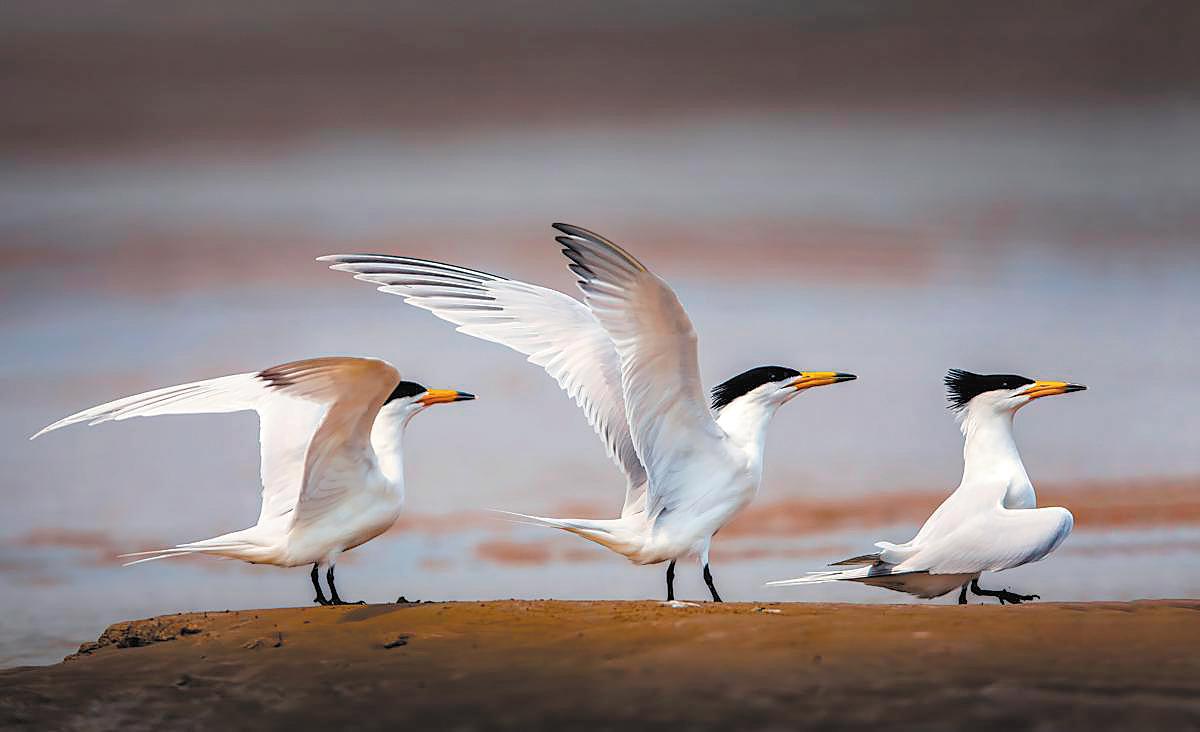
Leveraging her identity as a "natural translator", Lin has spent years fostering cooperation between the two sides. The annual seminar on cross-Strait Chinese crested tern conservation has become a platform for experts from the two shores to share data and experiences.
In 2023, the seminar announced that the global population of the species had surpassed 200. "That moment of excitement and pride belonged to every cross-Strait colleague who contributed," Lin said.
In April, Lin launched a program to recruit bird surveyors from the mainland and Taiwan for scientific monitoring, bird surveys and image documentation, bringing researchers from Taipei, Matsu and other places in Taiwan into the wetlands of the Minjiang estuary to observe the birds.
In November, she participated in organizing an exhibition at the Taiwan Guild Hall in downtown Fuzhou, featuring the collaborative efforts from both sides of the Taiwan Strait to protect the rare birds. The event featured a 7-meter-long scroll of the tern migration route painted by families from both sides. "When the scroll unfolded, I felt deeply that we were protecting not just birds, but our shared cultural memory and spiritual home," she said.
Juan Jin-song, former chairman of the Wild Bird Society of Taipei, said the cross-Strait collaboration on bird protection has covered sharing environmental data, co-authoring bird breeding management manuals, alternating patrols on uninhabited islands, and crackdowns on the theft of eggs.
Lin's advocacy now extends to the Fuzhou-Matsu integrated living circle. Just as the birds commute, many Matsu residents now live and work in Fuzhou. Lin actively uses her platform to propose policies that make their lives more convenient, ensuring the "shared destiny" of the birds is reflected in the ease of human exchange.
Contact the writers at zhangyi1@chinadaily.com.cn


- HKSAR govt commemorates 81st anniversary of victory of Chinese People's War of Resistance Against Japanese Aggression
- Tracks laid for new high-speed railway
- 2026 Yidan Prize laureates announced in Hong Kong
- China's Tianwen 3 mission aims to lead in Mars sample return
- China activates flood alert for Jiangxi amid heavy rain forecast
- Six killed, three injured in Haikou restaurant fire





