



China completes first landing, takeoff test of manned lunar lander









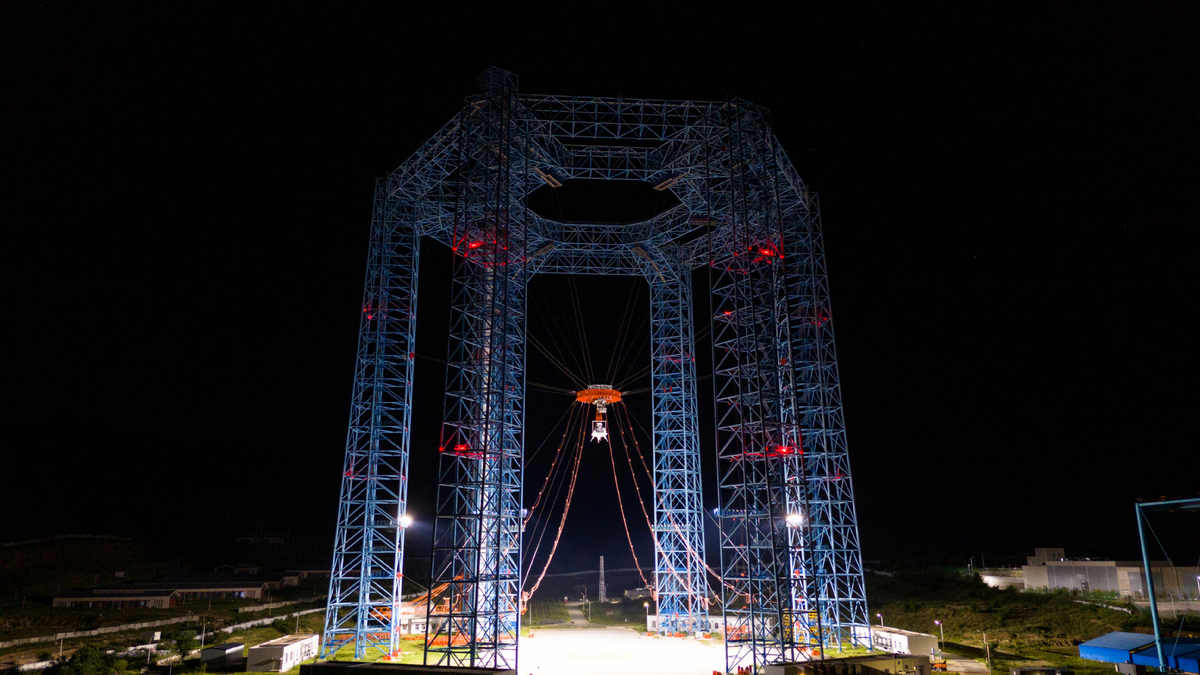
HUAILAI, Hebei -- China on Thursday announced that it has successfully completed a comprehensive landing and takeoff test for its manned lunar lander at a test site in Huailai county, North China's Hebei province.
The test, completed on Wednesday, represents a key step in the development of China's manned lunar exploration program, and also marks the first time that China has carried out a test of extraterrestrial landing and takeoff capabilities of a manned spacecraft, the China Manned Space Agency said.
The lunar lander, named Lanyue, which means embracing the moon, consists of both a landing module and a propulsion module. It is a newly developed spacecraft designed to support crewed missions to and from the moon.
It will be used to transport two taikonauts between the lunar orbit and the lunar surface — and will carry a lunar rover and other scientific payloads. After landing, the lander will serve as a life-support center, an energy center and a data center, offering assistance and serving as a base for the taikonauts' stay and activities on the moon's surface.
Noting that the test was complex with a long cycle and technical challenges, the space agency said the success represents a breakthrough in research and development in terms of China's manned lunar exploration program.
China aims to land its astronauts on the moon before 2030, with the purpose of conducting scientific exploration.


- The Morandi show in Shanghai
- Inner Mongolia's ecological zone demonstrates desert control
- China sends new batch of low-orbit internet satellites into space
- Influencers from Myanmar explore Shanxi culture, scenery
- Technology empowers modern agriculture in China
- Pingliang, where ancient wisdom meets modern wellness





