



Chinese scientists reveal discovery of osteoarthritis pathogenesis mechanism









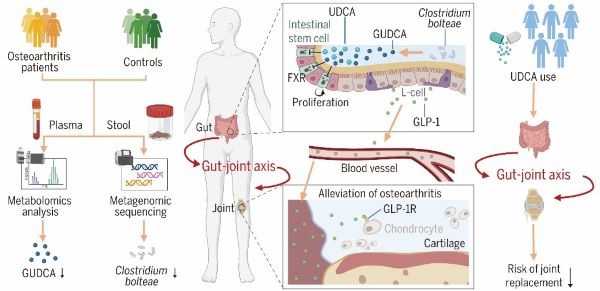
BEIJING -- A Chinese research team has uncovered a previously unknown "gut-joint axis" mechanism that drives osteoarthritis, revolutionizing the understanding of this degenerative joint disease, according to the Chinese Academy of Sciences.
The current understanding of osteoarthritis pathogenesis remains incomplete, and no safe, effective disease-modifying drugs are available at present. Identifying disease mechanisms and therapeutic targets, and developing treatments are active research priorities.
While osteoarthritis manifests as localized joint degeneration, previous focus on localized factors as core etiology has meant that systemic contributors are poorly understood.
By analyzing two independent Chinese cohorts, researchers from the CAS' Shanghai Institute of Materia Medica and Xiangya Hospital of Central South University found that osteoarthritis patients had significantly lower blood levels of bile acid GUDCA, which correlated with disease severity.
Animal experiments demonstrated that GUDCA alleviates osteoarthritis by inhibiting the intestinal FXR receptor and increasing glucagon-like peptide-1 (GLP-1) production.
Published in Science with an accompanying commentary, the results of the research provide clinical evidence that can be used to target the gut-joint axis in osteoarthritis treatment and break the established theory that osteoarthritis is caused by local factors.


- Chinese ecologist Ma Keping elected UNESCO MAB council chair
- 2026 AID China steps into silver future
- Guizhou's 1st EV export train on track for Central Asia
- Fashion show exhibits richness of China's ethnic diversity
- Norway launches nationwide seafood campaign in China
- Beijing's robot 4S store showcases embodied AI in action





