



Life made easier as farmers turn to tech









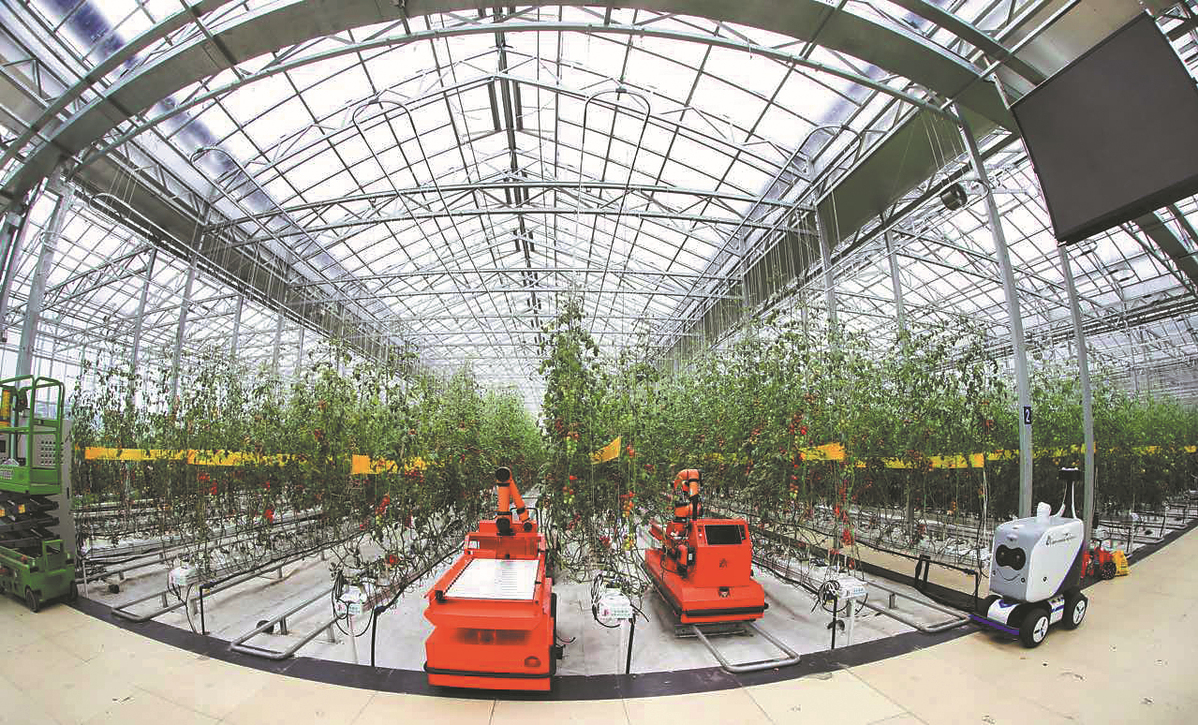
Soilless technologies
Farmers in northern Shouguang, which has soil with a high salt content, produce tomatoes by using soilless growing technologies.
In villages at the Shuangwangcheng Ecological Economy Development Center, these crops are produced by such methods that use a mix of sand and cinder.
Farmers in the area said 60,000 yuan ($8,736) worth of tomatoes can be produced on each mu (0.067 hectares) of land on which such methods are used.
Two decades ago, farmers in these villages only earned 500 yuan from each mu of land due to the soil's high salt content.
Han Xiangjun, who farms in Nanqiaomu village, said, "The local soil used to be dubbed 'white land', as the high salt content left a distinctive 'frost' on the top layer.
"On this soil, we could only plant cotton, which had a low yield."
Farmers in the village have used soilless technologies to grow tomatoes in greenhouses since 2000.
"We use a drip irrigation system to water the crops and provide them with nutrients, which saves a considerable amount of water," Han said.
"Using a soilless growing mix allows us to produce healthier crops without the threat of soil-born diseases. Plants grown in soilless mixes are also less likely to be affected by pests.
"If the soilless growing system is working correctly, it requires extremely low maintenance, and can result in a high output."
As farmers become skilled in using soilless technologies, they are growing more types of fruit and vegetables to increase their earnings.
Cui, the Cuilingxi villager, said: "Smart technologies have made our work much easier and more efficient. Being a farmer is no longer as hard as it used to be."
zhaoruixue@chinadaily.com.cn


- Anhui Medical University celebrates centennial milestone
- Capital Airlines resumes Qingdao-Vancouver direct flights
- World's tallest tower for gauging wind completed
- Heritage plan stresses digital tech, cooperation
- Shanghai airport opens exhibition of Asia's largest fin whale skeleton
- China's railway passenger trips hit record single-day high





