



Don't pollute with light









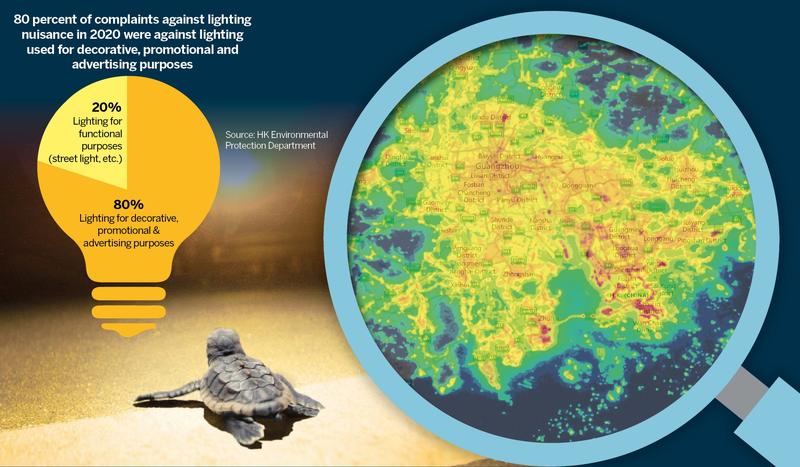
Mei noted that none of the world's major city clusters, like the Tokyo Bay Area or the San Francisco Bay Area, have adopted Dark Sky planning. The Guangdong-Hong Kong-Macao Greater Bay Area could potentially be the first cluster to plan and implement comprehensive Dark Sky zoning.
Liang Zheng, director of the Shenzhen branch research center for urban lighting planning at the China Academy of Urban Planning and Design, said that the past decade saw cities install light shows and giant outdoor LED screens. These can be curbed to better serve sustainable, green development.
Stargazing eco-tourism also has the potential to develop alongside Dark Sky parks, Liang said. In Chile and the US, economic benefits to the local communities have been generated without ecological harm.
Taiwan set up Asia's third Dark Sky Park at the Hehuan Mountain in 2019. The illumination of the park was reduced and the spot has become an eco-tourism landmark. It also propelled other places to develop stargazing tourism, according to Liu Chih-an, president of the Taipei Amateur Astronomers Association, one of the project's initiators. Last December, Taiwan's Lienchiang county passed the island's first legislation on light pollution control.


- Xi urges China, DPRK to maintain strategic resolve, deepen cooperation
- China, Namibia upgrade ties, pledge to boost exchanges
- Grand Canal forum in Wuxi gathers wisdom for modern development
- Drones provide rapid air support after Guangxi floods
- Fujian rolls out emergency measures as it braces for Typhoon Bavi
- From countdown to capture: Witnessing a rocket's milestone





