



Quake-hit Jiuzhaigou's water environment restoring: remote sensing study









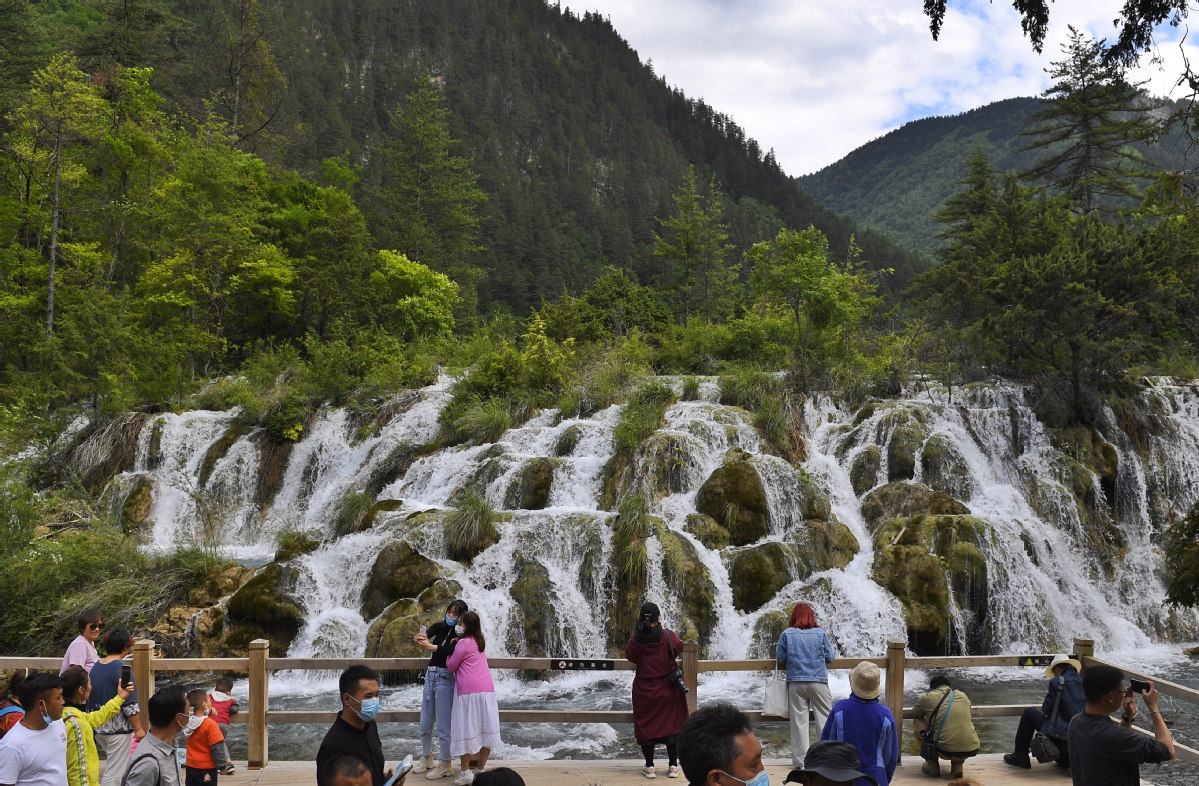
BEIJING -- A remote sensing study shows that the water environment of the Jiuzhaigou scenic spot in southwest China's Sichuan province has started to rehabilitate after being hit by an earthquake, according to the Chinese Academy of Sciences (CAS).
Jiuzhaigou National Park, a UNESCO World Heritage site famous for its spectacular waterfalls, lush forests and serene plateau lakes, was hit by a 7.0-magnitude quake on Aug 8, 2017.
Researchers from the Aerospace Information Research Institute under the CAS and UNESCO's International Center on Space Technologies for Natural and Cultural Heritage (HIST) conducted remote sensing monitoring and field scientific investigations to evaluate topography, bodies of water and vegetation in Jiuzhaigou after three years of restoration and reconstruction.
Results revealed that the water environment in the core area of Jiuzhaigou is gradually recovering. Remote sensing images on June 3 showed that the water in Jiuzhaigou reached more than 220 hectares. At the same time, it is still necessary to guard against geological disasters such as landslides and mudslides.
The team also used three-dimensional lidar scanning and unmanned aerial vehicle survey technologies to evaluate the environment in Jiuzhaigou, providing scientific data and technical support for disaster prevention and ecological restoration in the area.


- Guizhou's 1.92 million mountain relocatees build new lives in urban areas
- Honeysuckle harvest brings prosperity to Hunan villages
- Fishing vessels cruise Victoria Harbor to mark 29th anniv. of Hong Kong's return to motherland
- Global experts gather in Yunnan to advance tropical biodiversity conservation
- Hybio challenges Eli Lilly with FDA bid for tirzepatide generic
- Flag-raising ceremony, reception held to mark 29th anniversary of Hong Kong's return to motherland





