



Dinosaurs that left tracks in stone identified









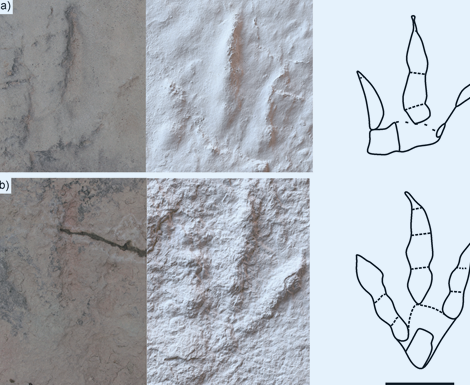
Dinosaur footprints that were discovered recently in the Junggar Basin of Xinjiang Uygur autonomous region, include tracks of what is believed to be a new species of Asianopodus, a Chinese research team announced on June 5.
The team, organized by the Institute of Vertebrate Paleontology and Paleoanthropology of the Chinese Academy of Sciences, found the footprints in an 80-square-meter layer of fine sandstone.
"We found 13 three-toed footprints on the stratum. The larger one is about 47 cm to 56 cm long and 31 cm to 42 cm wide, and they are shaped like a 'V'. The smaller one is about half the size of the larger one," said Wang Xiaolin, the leader of the team and a senior paleontologist at the institute.
The team analyzed the sizes and shapes of the footprints, which were similar to a brontosaurus's, and then categorized the track as part of the Asiatic footprint genus.
"We have identified both of the footprints we discovered as carnivorous theropods. The bigger one is a little bit different from the Asiatic dinosaur footprints that have been found before, so we named them the Niu's Asian footprints — a new species that belongs to the largest species of Asianopodus," Wang said.


- Beijing develops elderly care system as population ages
- Unauthorized fireworks test caused February Yicheng explosion that killed 12
- Shanxi court sentences 41 people over fatal mine accidents
- Gen Z finds a sweet future in hometown's green transition
- Rice paddy art transforms Yellow River Estuary village into gallery
- Ningxia expands stargazing tourism with cross-regional travel routes





