



Discovery of bird fossil unravels plateau's past









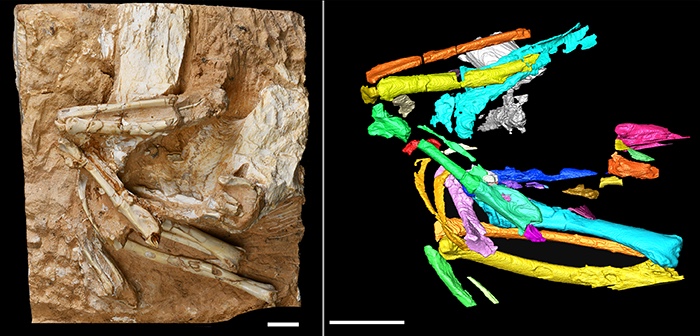
BEIJING-Chinese scientists have found the oldest sandgrouse fossil in Asia embedded in rocks dating back 6 million to 9 million years in northwest China's Gansu province.
The discovery of the new species in the arid environment near the edge of the Qinghai-Tibet Plateau, gives clues as to how the ecosystem there developed.
The species, found by researchers from the Chinese Academy of Sciences' Institute of Vertebrate Paleontology and Paleoanthropology has been named Linxiavis inaquosus, and fills a gap in the sandgrouse fossil record.
The fossil of the partial skeleton includes the shoulder girdles, wishbone, bones from both wings, vertebrae, and part of a leg. Unfortunately, the skull is missing, researchers said.
The discovery was recently published in the journal Frontiers in Ecology and Evolution.
"As the oldest fossil of a sandgrouse in Asia and the most complete fossil known from the group, the new skeleton provides a key link in expanding our understanding of the evolution of the sandgrouse living in China today, as well as the ecosystem associated with the Qinghai-Tibet Plateau and the species that live only there," said Li Zhiheng, first author of the study.
Sandgrouse are a group of 16 species of birds related to pigeons that live in some of the most arid areas across Europe, Asia and Africa. The association between sandgrouse and dry environments has helped scientists determine that the area next to the Qinghai-Tibet Plateau was equally arid when Linxiavis inaquosus lived during the period known as the late Miocene.
Xinhua


- New high-speed rail section to link Xiong'an, Shangqiu
- Chinese doctors perform first ENT surgery in a flying hospital in Kyrgyzstan
- Pearl S Buck's literary works guide China-US people-to-people exchanges
- China's Shenzhou XXIII astronauts send Mid-Autumn Festival greetings from space
- Yuelu Conference draws AI experts to discuss future industries
- WorldSkills Competition benefits career development





