



This Day, That Year: June 18









Editor's note: This year marks the 70th anniversary of the founding of New China.
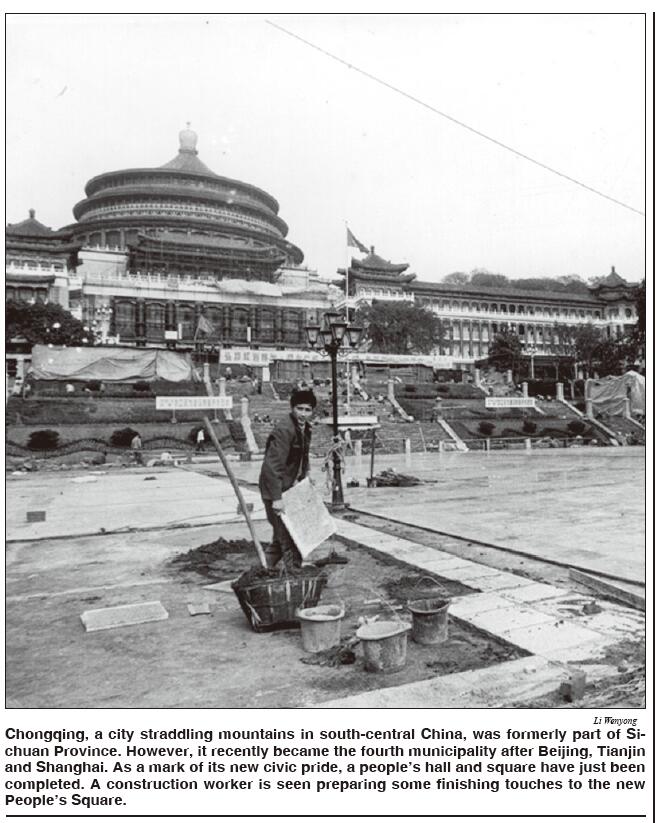
On June 18, 1997, Chongqing was officially upgraded to become China's fourth municipality after Beijing, Shanghai and Tianjin.
The new status aimed to help develop the central and western regions.
From 1954 to 1997, the city was under the jurisdiction of Sichuan province. An item on May 9, 1997, from China Daily showed a construction worker giving the final touches to the new People's Square in Chongqing.
Since then, Chongqing has played an increasingly important role in the country's development strategy.
In February 2010, it became one of the country's first batch of national central cities along with the other municipalities.
National central cities are the highest-level cities in China, and they have the core function of driving development of their regions and serving the entire nation.
In June 2010, Liangjiang New Area was established in Chongqing, which was the third national development zone in China, approved by the State Council, China's Cabinet, after Shanghai Pudong New Area and Tianjin Binhai New Area.
A metropolis with more than 30 million people, Chongqing has a dynamic economy: GDP exceeded 1 trillion yuan ($144.4 billion) for the first time in 2011.
In April 2017, the central government announced the launch of the China (Chongqing) Pilot Free Trade Zone.
The zone, spanning about 120 square kilometers, comprises three parts - Liangjiang New Area, Xiyong and Guoyuan Port.
As the only municipality in western China, the traditional industrial hub, located at the intersection of the Belt and Road Initiative's trade route and the Yangtze River Economic Zone, has witnessed fast economic growth.


- Capital Airlines resumes Qingdao-Vancouver direct flights
- World's tallest tower for gauging wind completed
- Heritage plan stresses digital tech, cooperation
- Shanghai airport opens exhibition of Asia's largest fin whale skeleton
- China's railway passenger trips hit record single-day high
- China's high-speed rail network expansion to facilitate cross-city collaboration





