



The great thaw









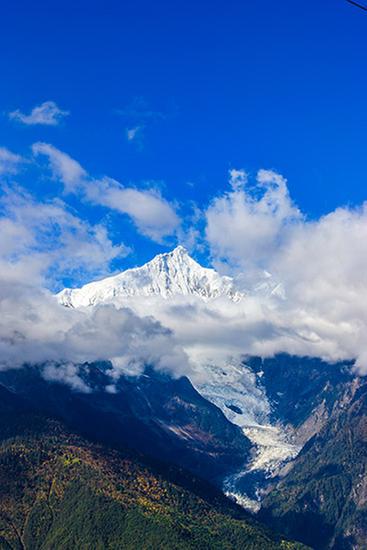 |
| Mingyong glacier, located on a subsidiary peak of the Meili Snow Mountain in Yunnan province, in October 2009.[Photo by Xu Dong/For China Daily] |
The rates of pullback and contraction, among other changes over 50 years, have varied from glacier to glacier. And, while within the world scientific community, there could be different opinions on the health of glaciers, measured largely by satellite data or on-site monitoring, there is little disagreement over the reason that has triggered the great thaw.
"Glaciers have experienced a universal retreat since the mid-19th century," Liu says. "But the acceleration in shrinkage has become more apparent in recent times."
Climate change, which is commonly known as global warming, is caused by man-made and natural activities, and glaciers are sensitive to it.
The Industrial Revolution (1760 onward) has contributed substantially to climate change.
According to a paper by the Institute of Tibetan Plateau Research, an affiliate of the Chinese Academy of Sciences, the central body in Beijing, glacial retreat in China has been noticed more among small mountain glaciers in the southwest of the Tibet autonomous region, where the mass deficit has been building up since the 1970s.


- Aviation body urges protection of cabin crew after viral in-flight incident
- 7 killed in illegal mining incident in Chongqing
- Traditional Zhuang brocade regains fresh vitality today
- Food an emotional bond with one's hometown
- English changed his life and then that of others
- Chongqing home preserves revolutionary history





