



Researcher spends 16 years studying snake









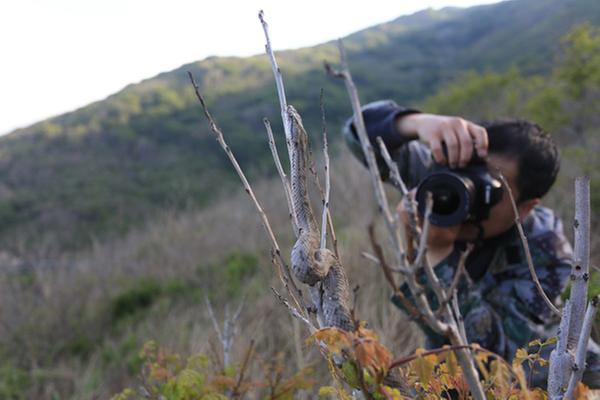 |
| Wang takes photos of a pit viper on Snake Island. ZHANG CHUNLEI/CHINA DAILY |
A snake must be held in the right place with a certain amount of pressure, otherwise it is able to turn its head and bite.
Wang was bitten on his left forefinger, causing his arm to swell up and leaving him hospitalized for 18 days.
"It was so painful that I wanted to cut my arm off," Wang recalled. "After that, I promised myself that I would not make the same mistake again."
Despite this one harrowing experience, Wang said he enjoys working on Snake Island.
"Snakes are like other animals. They are clever, and if you spend enough time with them, you start to love them," he said.
In addition to basic research, Wang and his colleagues cooperate with universities and research institutions for research subjects on the Shedao pit viper.
In his spare time, he lectures students on environmental protection in Dalian's Lyushunkou district.
Every autumn, tens of millions of birds, migrating south to their wintering grounds, make a stopover on the island before flying across the Bohai Sea.
To publicize the nature reserve, Wang took up photography, taking images of the snakes, birds and plants he encounters.
"Statistics show that 340 species of bird frequent the reserve, and I have captured images of 270 of them using my camera," Wang said.


- World's tallest tower for gauging wind completed
- Heritage plan stresses digital tech, cooperation
- Shanghai airport opens exhibition of Asia's largest fin whale skeleton
- China's railway passenger trips hit record single-day high
- China's high-speed rail network expansion to facilitate cross-city collaboration
- A lifelong guardian of children's breath





