Public banks help fund development initiatives
Updated: 2012-08-20 08:02
(China Daily)
|
|||||||||||



Bangladesh teems with attractive investor opportunities across a number of sectors
Over the last three decades, Bangladesh has experienced something of a banking boom and now has 48 commercial banks in operation and a buoyant stock exchange.
While most banks are privately owned, there are four State-owned banks working with the government to organize capital for strategic infrastructural projects.
The most highly capitalized of these is the Sonali Bank Ltd, which has authorized capital of Tk. 2,000 Crore ($245 million), and Tk. 1,125 Crore ($138 million) in paid-up capital.
Soon after Bangladesh' s independence in 1971, Sonali Bank emerged as the largest and leading Nationalized Commercial Bank by proclamation of the Banks' Nationalization Order 1972, liquidating the then National Bank of Pakistan, Premier Bank and Bank of Bahawalpur.
As a fully State owned institution, the bank had been discharging its nation-building responsibilities by undertaking government entrusted different socioeconomic schemes as well as money market activities of its own volition, covering all spheres of the economy.
The bank was then converted to a Public Limited Company with 100 percent ownership of the government and started functioning as Sonali Bank Limited from Nov 15 2007 taking over all assets, liabilities and business of Sonali Bank.
After corporatization, the management of the bank was given the autonomy needed to make it competitive and be able to run its business effectively.
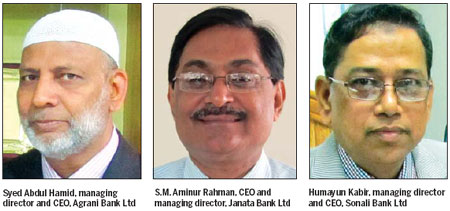
Humayun Kabir, managing director and CEO, who took over the bank in May 2010, oversees nearly 22,000 staff and 1,198 branches, takes up the story.
"We are not only working in the urban sector, but with the rural population too. We are providing them with loans, and have started micro credits in two places, with a view to reaching 10 or 12 villages. We are also financing programs for the empowerment of women," he said.
"Many of our entrepreneurs are importing from China. China is also helping them set up factories and plants. We will finance projects that can be supervised by us. The relationship we have with China is very positive: Chinese investors and entrepreneurs have always come to Bangladesh."
Efficient and competitive
The award-winning Janata Bank Ltd is also actively participating in the socio-economic development of the nation by providing credit to viable borrowers, efficiently delivered and competitively priced products, while simultaneously protecting depositors' funds and providing a satisfactory return on equity to the owners.
As well as boasting 879 branches, including four in the United Arab Emirates, Janata Bank is also linked with 1,202 foreign correspondents around the world.
"Things are very exciting here," said S. M. Aminur Rahman, Janata Bank's CEO and managing director. "Bangladesh is the world's fourth-largest garment exporter and we are allowing producers to increase volume. International buyers, such as Marks and Spencer's, are buying from us because we offer excellent quality, especially our denim.
"We are also playing a very important role in the industrialization of our country. We are investing in the power sector, and have financed a number of power plants, and sectors that are not traditionally related to the exports of the country. Bangladesh is an agricultural country so we are also extending our support to the agro-business sector. We are also financing exports for ship building, gas exploration, oil refining, heavy engineering and agro-business, so the investment climate here is very positive because of cheap labor costs and a skilled labor force. Any investor interested in working with us can visit our website and see the products we have, the sectors we are investing in and the environmental climate of the country.
"The government is offering facilities to repatriate profits of the international companies that invest here, so they can play a vital role.
"Investors are efficient and expert; they will be able to see for themselves what the banking sector is doing here and if there is any possibility of investing or creating a joint venture. Janata has already extended its loan facilities to international investors so they have a local partner."
Serving the nation
With a slogan that states it is "committed to serve the nation and its people", the Dhaka-based Agrani Bank Ltd delivers retail, corporate and personal banking through its 874 branches.
As well as providing a diverse range of services, including loans, to help local people better themselves, the bank is calling on Chinese investors to enter the market now to help create more jobs and ignite the economy.
Agrani Bank's Managing Director and CEO Syed Abdul Hamid: "A giant economy such as China has the scope to invest, particularly in coal or mining, or in the areas of gas exploration, energy and infrastructure development.
"These are priority areas and they require a huge amount of money. If we can provide these facilities, particularly train communications and a deepsea port, other areas will obviously benefit."
The bank plans to create employment for around 50,000 people this year though loans and advances, including 2,000 through direct employment, and performance continues to be high.
"Last year our deposits grew by 25 percent, mostly from the middle class. Due to the current shock in the stock market, the growth of deposits in Agrani Bank is not increasing as fast as previous years, because many people have lost capital in the stock market. The middle-class is unable to sell its money this year, but next year, growth will ensue again.
"As far as I can see, the Bangladeshi economy will have the same growth as India. Bangladesh is a country where everyone is doing business - the mobile sector for example is 10th in the world ranking. We believe all our sectors should be that good."
Last but not least, Rupali Bank Ltd is looking to become one of the top three banks in Bangladesh within three years. Formed through the merger of three erstwhile commercial banks, namely Muslim Commercial Bank Ltd, Australasia Bank Ltd and Standard Bank Ltd in March 1972, and corporatized in December 1986, Rupali today boasts authorized capital equivalent to $120.7 million and paid up capital of $21.55 million.
Managing Director and CEO Farid Uddin is delighted China has become a strong partner to Bangladesh, and is looking forward to more joint ventures in the future.
"In a country like Bangladesh, there must be development of capital and human resources. Our population is growing fast and we need huge funds to manage that population," he said.
"As such we must develop our energy sector, and China is in a position to play a strong role. Industrialization is also key to our development, and this is where Rupali Bank plays a fundamental role. We need to increase the capacity of our energy sector from its present 4,000 megawatt to at least 7,000.
"We have provided 60 billion Tk to five customers in the last year, who have jointly supplied 300 megawatt. Our country wants to develop. We need change in all sectors and we need international communities to understand our challenges so they can help and take advantage of business opportunities. For our part, we need to change our administrative procedures, our policies, political stability and our planning system.
"We have an annual development program based on the economic situation of the country and the international aid we receive. What we plan makes a difference for our country.
"We work hand in hand with the Ministry of Finance to make the best policies and the best allocation of macroeconomic priorities. We finance a lot of agricultural, trade, export, energy and industrial projects and this makes a huge difference to the way the country grows.
"Housing is another responsibility we must undertake and through syndication, we have become a leading institution in making housing affordable for the general population."
InFocus provided the story.
(China Daily 08/20/2012 page6)






Editor's Picks

|

|

|

|

|

|