Bangladesh seeks capital investment
Updated: 2012-08-20 08:02
(China Daily)
|
|||||||||||


Energy and infrastructure outlays could put Bangladesh on course for double-digit growth
One of China's most valued neighbors, thanks to a thriving partnership in garment exports, Bangladesh is working hard to attract investment in infrastructure and power generation - the tools needed to change the dynamic of its economy.
Growing at an average rate of 6.8 percent and with export revenues up by 40 percent in 2011 from the previous year, Bangladesh's private-sector led economy is currently the third-highest performing in Asia. Pundits believe double-digit growth could be within easy reach if investment in even one single hydroelectric power station was made, and Bangladesh is looking to China and other potential partners in helping it close up the 3,000 megawatt shortfall.
The limited, regulated external exposure of the country's banks cushioned it against the effects of the global economic crisis. It has a good range of incentives and free zones to entice investors and benefits from a young, and driven workforce.
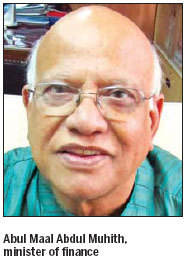
Minister of Finance Abul Maal Abdul Muhith, 78, explained the current climate. "We have had many proposals from foreign investors, including China, to relocate their industrial plants here because we offer very low-cost labor, a strategic location between China and India, and a growing market of 161 million people," he said.
"This government has placed huge importance on transit, not only because it allows the free movement of goods, but principally because it would convert Bangladesh into a regional economic power. We have increased public expenditure to 17 percent, and my target before I leave office is to reach 20 percent.
"To achieve this aim, I cannot rely on domestic investors. As a new initiative, we have made private-public partnerships an integral part of the budget, as public contributions are needed for ensuring feasibility studies, land use and such things. We are generating foreign interest in precisely the sectors that need the most support, such as transport and power generation. We are not just producing garments anymore, but sophisticated goods, such as pharmaceuticals."
As one of the largest pharmaceutical companies in Bangladesh, Incepta Pharmaceuticals Ltd has embraced the growth curve by renovating its manufacturing plant to state-of-the-art, world-class standards.
Fast-growing Incepta started its business 11 years ago and now boasts more than 600 generic brands and a turnover of more than $100 million. Incepta exports to 35 different countries, and has strong business links with Europe and more recently the US and China will also be important to its growth, as Managing Director Abdul Muktadir explained:
"China provides us with the raw materials required for the medicines," he said. "In addition to other enterprises, we have established two different companies, one dealing with vaccines, and a biotechnology enterprise. We have very good links with Chinese firms for both these businesses."
Incepta is also planning to set up a raw material company with Chinese assistance so that it can keep more of the value in Bangladesh.
"Because of our established network, we would export the finished formulas to the US and EU," Muktadir said."Our products are exactly the same as those of any multinational: we follow the same international quality standards and quality assurance procedures established and approved by the regulatory authorities. We are proud to represent Bangladeshi brands abroad."
As well as being committed to growing Incepta, Muktadir also champions high-level education in his country. "There are many organizations taking care of primary education, but I would like to create intellectual property," he said. "I am at the forefront of establishing a university in the fields of electrical, industrial engineering, pharmaceutical science and biotechnology.
"I am also looking into setting up an initiative to fund 20 intellectually gifted young people from Bangladesh every year and educating them in the best universities in the world. The idea is to generate a class of professionals that will be visible in the international arena, where people can see Bangladesh is contributing to the development of science.
"Within 30 or 40 years, Bangladesh will be a very developed country. If you look into the mindset of people in the city, you will see that very early in the morning, people are buzzing and the hard work continues round the clock."
More than half of Bangladeshis are employed in the agricultural sector, with rice the principle commodity. The Multimode Group, one of the leading names in the sector, has invested heavily in research and development , as well as production technology in an attempt to modernize the system.
"We have signed two agreements with Chinese companies and are working closely with them, first to learn the technology needed to produce hybrid seeds, which is very difficult, and also to help with the intensive farming of cattle," said Abdul Awal Mintoo, chairman and CEO of Multimode Group.
"It is crucial now that we increase the productivity of our livestock because the Bangladeshi middle class is growing very fast. We currently import 80 percent of our milk, and provide ourselves with only 18 percent of the meat we eat."
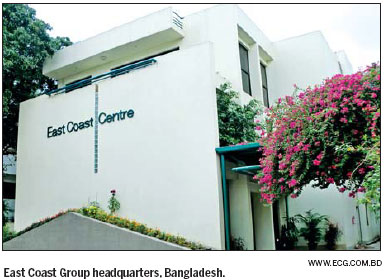
Bangladesh's excellent location makes it well positioned for shipping companies sailing between East Asia and Africa and Europe. East Coast Bulk Carriers, a subsidiary of the highly successful family-owned East Coast Group is one enterprise capitalizing on this strong link. "We have two vessels right now, one of which is the largest ship in Bangladesh with a 107,000-ton capacity," said East Coast Group CEO Tanjil Chowdhury.
InFocus provided the story.
(China Daily 08/20/2012 page6)





Editor's Picks

|

|

|

|

|

|