Gao Tiancheng - leader of town, spirit of reconstruction
Updated: 2011-05-03 13:52
By Tang Zhi and Li Jing(chinadaily.com.cn)
|
|||||||||||


 |
|
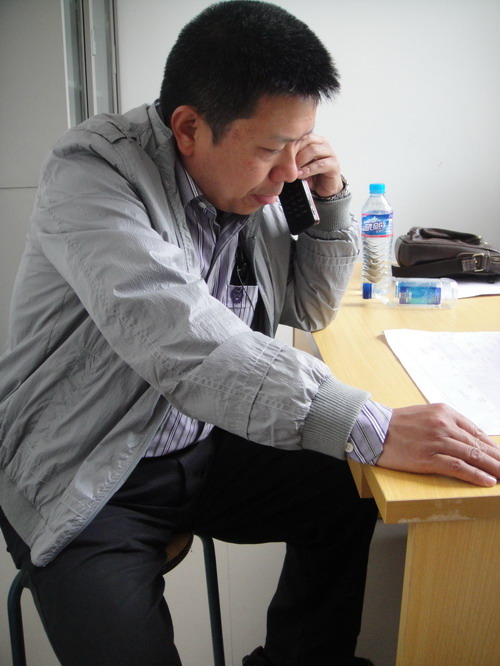
During the interview, Gao’s cell phone rang constantly. He was entirely occupied with his work and felt quite happy when he did see Bailu’s progress. |
Gao Tiancheng, head of the Bailu township, Sichuan province, led his people as they commenced rescue work shortly after the devastating 2008 earthquake. Later, he acted as the core spirit of the restoration and reconstruction work.
Gao was the last person to whom we conducted an interview with on our first-day-visit to Bailu, because his schedule had been fully arranged. Judging from the manner in which he behaved, Gao struck me as a capable and experienced man, which was proved when I looked at his resume. He had spent four years in the army in the late 1980s, which equips him with the needed courage and capacities to shoulder these heavy responsibilities.
"Bailu enjoys an abundance of mineral resources, which is why the colliery industry was quite well-developed before the earthquake.” Gao told China Daily. “But it is not a sun-rising industry and Bailu’s environment was seriously damaged. So we decided to completely switch to tourism after the quake.”
Before the quake, the mode of tourism in Bailu was quite elementary—Farm inns and wedding-photo-shooting around the Shangshuyuan Church. However, “to develop tourism in Bailu is one of the goals we are firmly pursuing.” Gao said. So we have to drive it along a more mature mode.” Here comes today’s French-style new shape.
Problems were sure to come along with such a huge transition. Gao told us he was quite confident that Bailu was sure to cope with the problems accompanying this change successfully.
Actually, Gao played a major role in leading the town’s transformation before the quake as well. He endeavored, from 2005, to persuade the bosses of local mines to close their “environmentally damaging business” and turn to tourism; yet some of them refused to do so. So Gao went to their mines and houses in person, repeating the merits of developing tourism instead of coal mines. In 2006, 11 mines with outputs less than 30,000 tons were shut down. It was in 2007 that the colliery industry ceased operations completely, which paved the way for developing tourism in Bailu.
Besides making irreplaceable contributions to the town’s material reconstruction, Gao also injected new faith into his people after the quake. Some even called him the “spirit of Bailu’s spiritual reconstruction”.
Yang Qinggui, a resident of Bailu who lost his son in the wake of the quake, praised Gao as a capable person with excellent speech talent and a loyal faith in life. “Once I was so depressed and pessimistic and thought only death could relieve my pain after the quake. It was Gao who encouraged me to cheer up and persuaded me back into life.”
During the interview, Gao’s mobile phone rang constantly. He was entirely occupied with his work and felt quite happy when he did see Bailu’s progress.
At last, Gao invited us to come to Bailu again in two years. “I assure you that everything in Bailu will get even better and better.”