OPINION> OP-ED CONTRIBUTORS

|
OPINION> OP-ED CONTRIBUTORS
|
|
Anatomy of a Japanese party before polls
(China Daily)
Updated: 2009-05-15 07:43 Democratic Party of Japan (DPJ) President Ichiro Ozawa finally announced his resignation on Monday. Had he acted sooner, we believe, his party would have managed to cut its losses. In the two months since Ozawa's state-paid aide was arrested in early March in connection with suspected illegal donations from Nishimatsu Construction Co., public opinion demanding Ozawa's resignation grew increasingly severe. Public ire even helped raise the approval ratings of the abysmally unpopular Cabinet of Prime Minister Taro Aso. Recouping not easy The next Lower House election must be held by September. But had Ozawa stayed on as the DPJ leader, the party could have suffered a defeat in the election and lost its chance to achieve its long-held goal of seizing the reins of government. We believe it was this sense of crisis that ultimately made Ozawa decide to step down. At his news conference on Monday evening, Ozawa said: "In order to bring about a change of government, I am willingly sacrificing myself and resigning from my post By burning my bridges, I am making absolutely sure that my party will triumph (in the next election)." Another factor that must have precipitated Ozawa's decision to step down was the recent moves within the DPJ to force him out. Until then, most party members had remained silent or noncommittal, at least on the surface. Since his aide's arrest, Ozawa has remained defiant of the Tokyo District Public Prosecutors Office, vowing to take it on. At Monday's news conference, too, Ozawa stressed that his conscience was "completely clear". It is possible that one reason why Ozawa dug in his heels for as long as two months was that he feared prosecutors could see his resignation as an admission of defeat. The prosecutors have not yet declared an end to the investigation, but people's attention is now beginning to turn to the first court hearing of Ozawa's aide, which will be held shortly. We believe Ozawa is now prepared to use the trial to challenge the manner in which prosecutors investigated the case and arrested his aide, and expect him to take issue with the prosecutors over the illegality of Nishimatsu's donations. The DPJ is wasting no time in proceeding with the selection of Ozawa's successor, but it will not be easy for the party to regroup. Before the Nishimatsu scandal broke out, the DPJ was on a roll and looked as if it was poised to seize power any day. But the party has since stalled. It has revealed its inner turmoil in its inability to take a clear-cut position on many of the bills presented to the Diet, including budget bills. The work of preparing its manifesto for the next Lower House election has been put on hold, too. Explaining policies to voters Why did Ozawa keep receiving huge donations from the general contractor for so many years? The DPJ has vehemently denounced collusion involving politicians, bureaucrats and businesses in connection with public works projects and promised to radically change the "structure of the nation". Was Ozawa not the very antipode of what the party stood for? Not only Ozawa, but also the rest of the party failed to address these obvious questions that many voters were asking. Now the party has to undo all the damage caused by letting voters' mistrust fester and grow. If the DPJ thinks it can automatically regain the public's trust once a new president is in place, it could not be more mistaken.
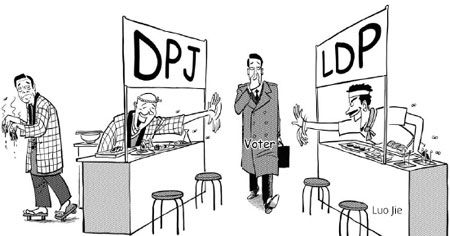 The election of the new president ought to take the form of multiple candidates competing on their policies. While the election's effects on Diet deliberations should be kept minimal, the party nevertheless needs to take innovative, proactive steps to take policy debates outside its walls so that the voting public can judge the DPJ's principles and goals. Another thing the party must do is to shed its habitual reliance on Ozawa as the "problem fixer" and establish a new party persona under the new leader. Ozawa was elected president three years ago to get the DPJ out of the mess over the fake e-mail fiasco. He went on to prove his competence by leading the party to a historic victory in the 2007 Upper House election that brought the chamber under opposition control. A former member of the ruling Liberal Democratic Party (LDP) and a brilliant election strategist, Ozawa is thoroughly familiar with the ins and outs of LDP-style campaigning. And having held a series of key LDP posts, Ozawa has remained one of the biggest names in Japanese politics. His background and personality have sometimes made a good number of voters and DPJ members uneasy. Yet for the DPJ, which appeared weak, Ozawa was seen as a potent strongman indispensable in the party's quest for power. Ozawa was likened to a strong but potentially lethal medicine for the DPJ. And sure enough, he caused some "side effects". For instance, after Ozawa became president, some of the party's signature policies disappeared from the campaign platform. They included a plan to raise the consumption tax to finance social security spending, and a promise to ban political donations from companies awarded contracts for public works projects. As for the DPJ's policies on introducing child-support allowance and eliminating tolls for expressways, the ruling coalition and others attacked them as "lacking in viable funding plans". In diplomacy, Ozawa made a series of eyebrow-raising comments that deviated from the party's basic position. For example, he caused a stir when he told reporters in February: "The US Navy's 7th Fleet is enough to secure the US military presence in the Far East." LDP accountable too In 2007, Ozawa tried to pull an arbitrary stunt by negotiating with Yasuo Fukuda, then prime minister, to form a grand coalition with the LDP. The attempt backfired, and Ozawa expressed his intention to resign, which he retracted a couple of days later. But as this episode illustrated, our impression of the DPJ under Ozawa's leadership was that it was overtly and almost shamelessly ambitious in its quest for the reins of power, and that the party's policies were secondary to political jockeying. The DPJ must now rush to reshape its foreign and domestic policies. Should the DPJ succeed in recovering from the mess, it will be the Aso administration's turn to face public scrutiny. Although the Cabinet's approval ratings have risen after plunging to an abysmal 13 percent, opinion polls still show that nearly 60 percent of the respondents do not support the Cabinet. This is certainly not a figure Aso can take lightly. Whether the LDP can win the next election under Aso has been a nagging concern among LDP members, and their voices may grow louder in the coming days. It is now the responsibility of our elected representatives, especially members of the nation's two major political parties - the LDP and the DPJ - to make sure that the next Lower House election truly enables voters to elect a government of their choice. Faced with a serious economic downturn and other problems, such as the aging of society, low birthrate and declining population, the nation is undergoing a period of major transition. In fighting a Lower House election at such a time, the LDP and the DPJ alike must compete on the persuasiveness of their respective policies and the personal appeal of their respective leaders. Which party will shape up first to gain campaigning advantage? There is not much time left. Asahi Shimbun (China Daily 05/15/2009 page9) |
