|
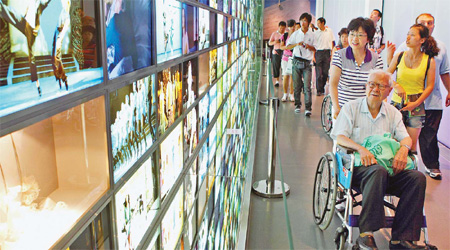
Visitors inside the Ireland Pavilion. Gao Erqiang / China Daily |
Exhibition focuses on human side of Irish society and ancient history to deliver maximum impact, Yu Ran reports.
The Ireland Pavilion presents the "Emerald Isle" as a country offering a fascinating blend of history, beautiful scenery and ancient culture rather than relying on high technology to dazzle visitors.
By showing the Chinese what ordinary Irish people look like, the pavilion aims to present a very human side of Irish society through five enclosed exhibition galleries. These present the country's climate, landscape, settlement patterns, lifestyle, architecture, technical innovation, research and educational opportunities.
"We are using the traditional Irish images of ancient buildings and monuments and the landscape and the scenery to convey a sense of what the country is like," said Jim Blighe, the pavilion's director.
The interior is simple and strives to give Chinese visitors a feel for the local environment. The entrance is perched on a hillock of green grass as green land accounts for 90 percent of Ireland's terrain.
On the way to the first gallery, a large light box and three walls of photographic panoramas show the elaborately carved entrance of Newgrange, one of the country's most famous prehistoric monuments. It was once used to house the dead.
The Faces Gallery displays simply arranged, checkered photographic images of both well-known and ordinary Irish people enjoying their lives on a digital screen wall.
In the central part of the pavilion, The Better Living Gallery looks like a fast-developing timeline, beginning with visual images of the country's past and ancient ruins, and finally evolving into modern cities and the interior of a contemporary apartment.
Although most of the exhibits in the five galleries at the pavilion rely on videos or pictures, this serves as a useful way of introducing the country's long history, ancient culture and modern urbanized lifestyle.
Ireland has experienced a great movement of people from rural to urban areas over the years. It relies on the collective spirit and wisdom of its people to absorb, learn from and manage this new experience.
"Global changes within modern societies brought on by settlement patterns and urbanization are something Ireland has always adapted to during its 6,000 years of history," said Blighe. "If countries stay true to their own customs and cultures, they can cope with whatever changes lie ahead."
Ireland, whose national symbol is a musical instrument, is famous for its traditional music performances. Numerous activities including art exhibits, classical instrumental performances, tap dancing and poem-reading seminars, have been organized inside the pavilion.
"I was surprised to learn about the history and cultural continuity of Ireland," said Zheng Tingqian from Hunan province. "I was also lucky to see the tap dancers perform traditional Irish music."
China and Ireland have operated a strong student exchange program in recent years, and the pavilion's staff is mostly made up of Chinese who have studied in Ireland. A few have even delayed their studies to work at the Expo and share their knowledge of Ireland with their Chinese peers.
"I've lived in Ireland for nine years and I am doing my doctorate at Trinity College in the University of Dublin. I put my course on hold last October in order to come back and work here," said Li Ming, 28, one of the pavilion's guides.
Visitors said they appreciated the knowledge and experience the guides brought back with them.
"I preferred walking with those staff who had been living in Ireland, because they introduced the country from a Chinese angle," said Miao Kan from Beijing. "I've never been to the country before but I'd love to go there as I was touched by their recollections and memories."
(China Daily 09/24/2010)