FTP helped coconuts crack global market









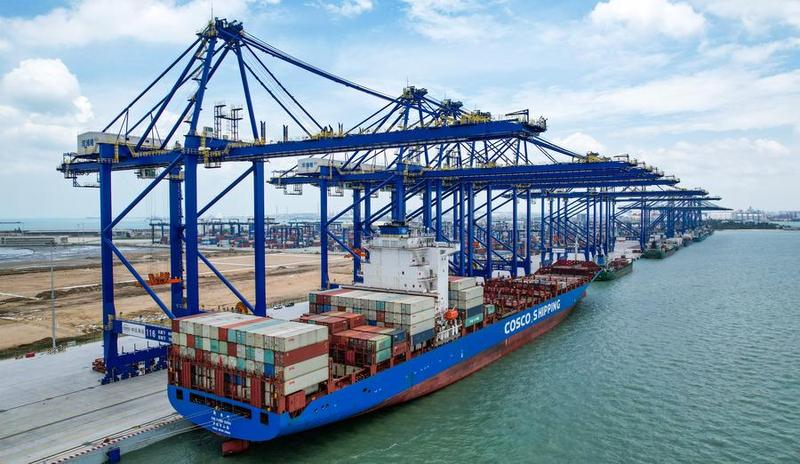
On Dec 18, Hainan Free Trade Port will launch its island-wide special customs operation. While global attention focuses on "duty-free shopping quotas" and "cross-border trade facilitation", in a small workshop amid the coconut groves of Wenchang in Hainan province, an artisan called Ahai is busy polishing coconut shells. Once discarded as waste by local farmers, the humble coconut shell has now acquired a place in global markets.
For decades, the coconut was a "familiar stranger" in Hainan. Its flesh produced sweet coconut water and soft desserts, but its hard shell remained underutilized. Traditionally, coconut shells were used as firewood or crudely made into bowls and spoons, fetching only a few yuan locally. Exporting them was not feasible, because tariffs and customs fees ate into the profits. "The profit from coconut craft could barely cover the customs agent's fee," Ahai's forefathers would lament.
But Hainan FTP's new customs framework — "freer access at the first line, regulated access at the second line, and free flow within the island" — opened new avenues for local industries. Simply put: foreign goods enter Hainan duty-free at "first line", Hainan goods entering China's mainland are taxed as required at "second line", and resources move relatively freely within the island. For coconut shells, this institutional redesign unlocked two distinct but mutually reinforcing value chains.
On the production side, the biggest change was the upgrading of manufacturing capacity by providing access to global inputs. Before the FTP was established, Ahai's workshop struggled to import natural dyes from Malaysia or precision carving equipment from Germany due to high tariffs. As a result, most of their output consisted of low-end products. But now these materials and equipment enter duty-free, enabling them to upgrade their production. FTP incentives, such as 15 percent corporate and personal income tax, lower their operational and labor costs, allowing Ahai to hire skilled artisans at higher wages.
Ahai's workshop now produces gradient-dyed coconut shells using Malaysian plant dyes and carves intricate lamps and jewelry with German tools. Both the quality and the value of the products have risen significantly. Domestic duty exemptions for processing further boost profitability, with value-added across the supply chain exceeding 30 percent.
Some feared that the special customs operation would turn Hainan into a "duty-free shopping island". But the opposite has happened: local culture has strengthened, paired with high-quality global consumption. Cross-border e-commerce allows these upgraded products to bypass traditional export hurdles, reaching European and American consumers within 72 hours via Haikou's "9610" export model.
At the same time, products made from coconut shells are being integrated into Hainan's cultural tourism economy. Duty-free stores, once dominated by cosmetics and luxury goods, now also feature Hainan coconut craft zones. Brooches inlaid with duty-free imported pearls, bookmarks with Li ethnic embroidery, and aroma holders paired with cross-border-sourced scents are on offer. These souvenirs are both locally distinctive and high-quality, which Southeast Asian tourists can take home and domestic tourists can ship internationally, enabled by the FTP's streamlined cross-border logistics.
Before the island-wide special customs operation, some also feared Hainan would become isolated from the mainland and global markets. But coconut shells prove otherwise. High-end crafts sell abroad under "first-line" access, while affordable daily-use items reach cities on the mainland through "second-line" channels, performing well in cultural shops and boutique hotels in Jiangsu, Zhejiang, and Shanghai. The FTP is not a market barrier but a connector that links local resources to global technology, traditional crafts to international high-end markets, and ordinary artisans to shared benefits.
The special customs operation also brings tangible benefits to residents. In Haikou, residents are likely to enjoy a 30 percent price drop on "cross-border coconut milk jelly" made with imported Thai coconut flesh and local coconut juice. Workers from a Qionghai processing plant can train in Singapore under FTP vocational programs, acquiring advanced coconut processing skills. Ordinary coconut farmers in Wenchang can label their products with "organic traceability", boosting purchase prices and transforming their businesses from raw material suppliers to branded producers.
Future "coconut stories" abound: fibers exported as eco-friendly materials to Europe, activated charcoal entering international high-end purification markets, or coconut-themed cultural tourism destinations akin to Penang's durian farms. The protagonists are artisans, frontline workers, and everyday consumers.
Hainan FTP's island-wide special customs operation is not an isolated loop but an open hub connecting domestic and international markets. When a simple coconut shell can leap across oceans in value, and a small workshop can access global markets, the island's vitality surpasses policy alone, illustrating China's pursuit of a higher-level open economy.
The author is a professor at the International Business School of Hainan University.
The views don't necessarily reflect those of China Daily.
If you have a specific expertise, or would like to share your thought about our stories, then send us your writings at opinion@chinadaily.com.cn, and comment@chinadaily.com.cn.