Opening up a new bridge between China and world










President Xi Jinping has made one point clear: China's opening-up is no longer about "catching up" — it is about leading. The launch of island-wide special customs operations on the Hainan Free Trade Port on Dec 18 is a vivid demonstration of that shift. At a time when the global landscape is shaped by uncertainty and geopolitical shocks, the move signals China's determination to push ahead with high-level opening-up and set a new benchmark for the country's next stage of modernization. Its impact will extend far beyond the island, shaping high-quality development during China's 15th Five-Year Plan (2026-30) period and generating new momentum for global development.
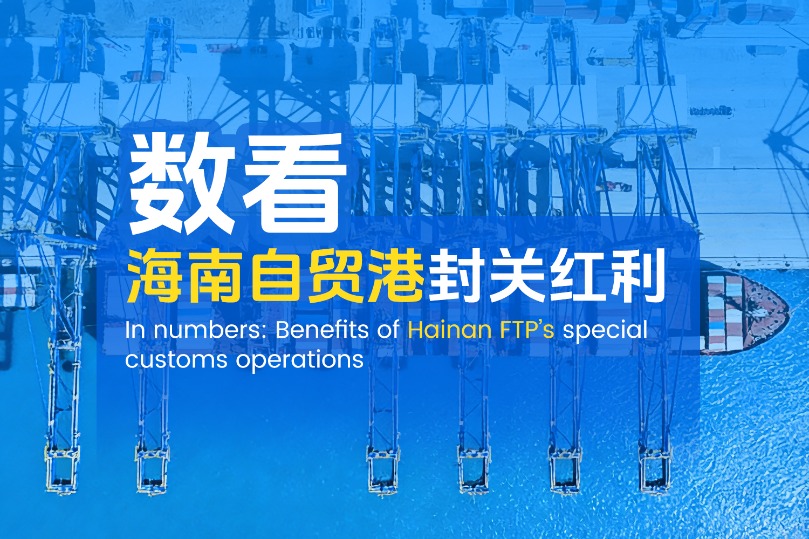
The transition is not a simple policy upgrade, but an institutional leap designed to bring Hainan FTP in line with the world's most competitive free-trade hubs. The most visible change is the expansion of zero-tariff treatment, a defining feature of globally recognized free ports. The scope of zero-tariff goods will increase from 1,900 tariff lines to roughly 6,600, raising coverage from 21 percent to 74 percent. This dramatically widens market access, eases eligibility conditions and benefits more companies and sectors.
Equally significant is the overhaul of the value-added regime. The new rules lower barriers for firms to qualify for duty exemptions, removing the previous requirement that at least 60 percent of a company's revenue comes from encouraged industries. The scope of eligible imported inputs has been expanded, now allowing zero-tariff goods to be used as qualifying materials. The formula for calculating value-added has also been refined, so the value of goods produced within Hainan can be counted toward the 30 percent threshold, making it easier for firms to meet the benchmark. In effect, Hainan FTP is offering a more predictable, flexible and modernized tariff environment.
A hallmark of leading free ports is a transparent, liberal and reliable investment climate. After island-wide special customs operations, Hainan FTP will further ease market access for foreign investors, roll out new reductions to the negative list and deepen reforms that strengthen both market entry and operational freedom. A commitment-based market entry mechanism will be further strengthened, allowing firms to begin operating once they pledge compliance, giving investors clearer expectations and a more predictable institutional environment. The goal is simple: to make Hainan FTP a place where clarity of rules, administrative efficiency and policy consistency become competitive advantages.
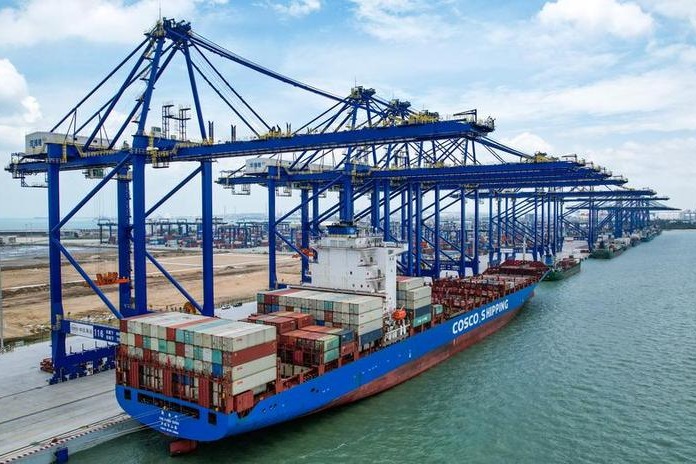
Moving goods, people and data in and out of Hainan FTP will also become easier. Entry-exit rules for professionals will ease, visa procedures will be smoother, shipping services will gain more autonomy as the "China Yangpu Port" registry expands and air-rights liberalization will accelerate. Digital connectivity will also advance rapidly. Cross-border data flows will be governed by a more agile negative-list system, while new international gateways and submarine cable projects will enlarge Hainan FTP's role as a digital-economy hub.
In a world where uncertainty is rising, the launch of island-wide special customs operations in Hainan FTP sends a powerful message that China's commitment to opening-up and support for high-quality development has not changed. It reassures global businesses and injects confidence into markets at a time of volatility.
The real economy will feel the impact quickly. The broadened zero-tariff regime would lower the tax of equipment importers by about 20 percent. Most zero-tariff goods — unless subject to quarantine or license control — will be cleared through "immediate release", sharply cutting the cost of customs procedures. The upgraded value-added rules will allow manufacturers to use local supply chains more effectively to qualify for duty exemptions. Meanwhile, the 15 percent corporate and individual income-tax framework, combined with freer mobility of capital, talent and data, will help Hainan FTP attract high-value, innovation-driven sectors.
For businesses, the new environment is an opportunity but also a test of strategy. Success will require a deeper understanding of Hainan FTP's institutional architecture. Companies in advanced manufacturing, modern services and the digital economy should assess whether Hainan FTP can become a node in their supply-chain design: a site for research and development, a base for high-end processing, a regional headquarters or a data hub. At the same time, firms must avoid models that rely on high-volume, low-value operations. Hainan FTP's comparative advantage lies in high-tech, high-value, globally connected industries, not in bulk commodity flows.
Compliance will be very important. Access to the 15 percent preferential income tax rate hinges on "substantive operations", not on shell registrations. Firms must demonstrate real management, staffing, assets and decision-making within the island to retain benefits, otherwise tax authorities may deny the preference and claw back unpaid taxes. Companies will also need to familiarize themselves with new customs procedures in order to fully capture efficiency gains.
Hainan FTP's island-wide special customs operations is a signal of how China intends to lead in the next phase of global integration. By delivering greater policy certainty, a sharper edge in openness and a more competitive business environment, Hainan FTP is poised to become a new front door for China's engagement with the world. And as global industries reassess supply chains and investment footprints, the island's role as a bridge — between China and international markets, between policy ambition and real economic opportunity — will only grow larger.
The author is vice-president of the Chinese Academy of International Trade and Economic Cooperation.
The views don't necessarily represent those of China Daily.
If you have a specific expertise, or would like to share your thought about our stories, then send us your writings at opinion@chinadaily.com.cn, and comment@chinadaily.com.cn.