



Broader unease at Board of Peace bypassing UN









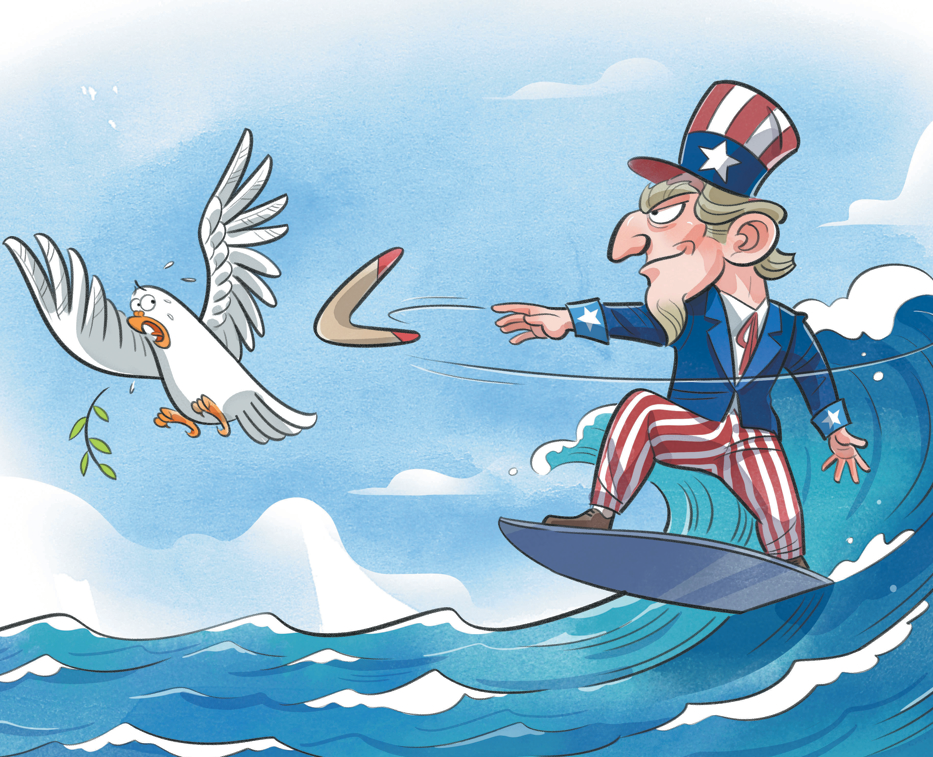
United States President Donald Trump recently announced the establishment of a new international body — the so-called Board of Peace — and invited roughly 60 countries and international organizations to participate in the endeavor. The draft proposal indicates Trump can be the "lifelong" chairman of this institution, and member states must pay $1 billion to secure permanent membership. Representatives from 19 countries attended its signing ceremony in Davos, Switzerland, on Jan 22.
A statement from the White House said the "Board of Peace" would provide strategic oversight in implementing the "20-point plan" for resolving the Gaza conflict. However, beneath this seemingly neutral statement lies a more complex political agenda.
The "Board of Peace" is supposed to be a multilateral organization. In reality, it is anything but. Decision-making will be tightly controlled by the US, particularly Trump himself. According to the White House statement, the institution will "operate under the leadership of President Trump" and six of the seven founding members of the executive committee are US nationals.
This structure alone turns the "Board of Peace" into a US-led substitute for the United Nations. Though the UN Security Council has acknowledged Trump's plan and welcomed the establishment of the "Board of Peace", it does not alter its inherently unilateral nature.
The draft proposal of the "Board of Peace" further exposes its true nature. According to documents obtained by Reuters, the committee will be "chaired by Trump for life" and member countries will only have a three-year term unless they pay $1 billion for permanent membership.
It is an innovation in governance where influence is no longer negotiated but purchased. The $1 billion membership fee violates the principle of sovereign equality in international relations. It effectively excludes most developing countries, turning the institution into a club for wealthy nations.
Trump's push for the "Board of Peace" is driven by multiple strategic considerations. In the short term, this move aims to consolidate his leadership on the Gaza issue and present himself as a "peacemaker". The board will oversee transitional governance and appoint senior officials of international peacekeeping forces.
In the long term, Trump seeks to reshape the international order by establishing a new mechanism that bypasses the UN framework. Trump has long been critical of the UN and accused it of being hostile to US interests. In January, he announced the withdrawal of the US from many UN agencies. The creation of the "Board of Peace" is his latest move to challenge multilateralism and pursue the "America First" policy.
The project will have a profound impact on global governance. First, it will weaken the authority of the UN. Several Western diplomats have warned that the mechanism could "undermine the role of the UN".
It could also fragment global governance further. The institution explicitly states that it will "first address the Gaza conflict, then expand to other conflicts". The model of paying large sums of money to secure permanent membership of an institution dominated by one country replaces multilateral negotiation with financial politics. Moreover, it could force countries to choose sides, thereby disrupting international solidarity and cooperation.
Notably, Russia, China, the UK and France all abstained from authorizing the "Board of Peace", citing concerns that the resolution did not clarify the UN role in Gaza's future governance. Their stance reflects the broader unease among major powers about bypassing the UN framework.
The so-called Board of Peace also suffers from fundamental legitimacy problems. While the UN secretary-general diplomatically stated that member states "have the right to form various cooperation mechanisms", he emphasized that the UN will continue to fulfill its established mandates and responsibilities.
The complexity of the Gaza issue is far beyond what a US-led institution can resolve. As acknowledged in the White House statement, Gaza requires "restoring core public services, rebuilding civil institutions and stabilizing daily life," all of which require widespread international cooperation and sustained political will.
The contrast is stark. In Gaza, children walk through the rubble searching for drinkable water, while in Washington, officials discuss how to allocate power and funds. Members of the "Board of Peace" discuss $1 billion permanent memberships in luxurious conference rooms, while the civilians of Gaza are struggling for their next meal. It not only exposes the brutal reality of international politics but also reminds us that true peace cannot be purchased with money, nor imposed through coercive power.
The author is a research fellow of Institute of State Governance at Huazhong University of Science and Technology.
The views don't necessarily reflect those of China Daily.
If you have a specific expertise, or would like to share your thought about our stories, then send us your writings at opinion@chinadaily.com.cn, and comment@chinadaily.com.cn.





