


Under-forest industry grows as economic pillar in Hunan
Bamboo businesses shoot up on the back of supportive policies










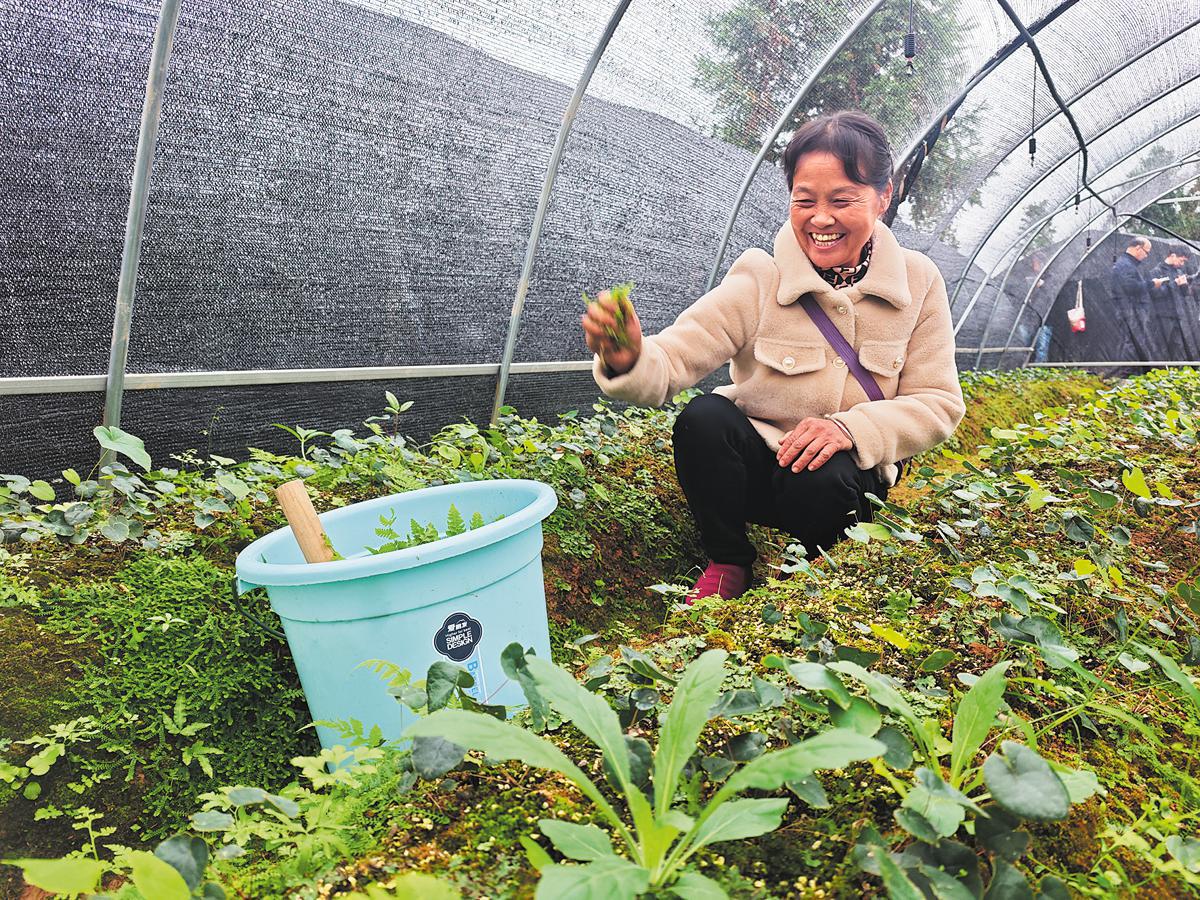
Su Zexiang, also from Xuanshui village, is another beneficiary of the local government's push to develop the non-timber forest economy.
Previously, her family relied on a 0.2-hectare orange orchard. As the trees aged, generating sufficient income became increasingly difficult. When the 60-year-old was considering abandoning the orchard, a company named Zhongxin Agricultural Technology offered a solution: leasing her land for 4,500 yuan per hectare annually to cultivate epimedium seedlings. Epimedium, commonly known as barrenwort, is a medicinal herb noted for its anti-carcinogenic properties.
Now, during her spare time from managing her own crops and household duties, Su undertakes planting and weeding work for the company at a daily wage of 90 yuan, earning her approximately 10,000 yuan annually.
Cai Yemao, the company's general manager, said that Su is one of over 50 villagers engaged in similar part-time work.
He highlighted epimedium's high market demand and the value of its entire plant, noting that once established, it can be harvested continuously for over a decade, with an annual output value of 150,000 to 300,000 yuan per hectare.
Cai said the company's base in Huoshenpo village, which borders Xuanshui, features 16 hectares of greenhouse space dedicated to epimedium seedling cultivation.
Although completed just last year, the base is projected to annually produce 10 million seedlings this year, generating an annual output value of 20 million yuan.
Many other traditional Chinese herbs, including poria, Siberian Solomon's seal, and Sarcandra glabra, are also cultivated across Hunan. Together with the bamboo industry, they form the foundation of a forest-based non-timber economy that generates 67 billion yuan in annual revenue.
As of Last year, this industry had utilized 2.4 million hectares of forest land and created jobs for over 3 million people, lifting the average annual income of these workers by over 2,800 yuan.
The forest-based non-timber industry in Hunan is expected to continue to grow.
"I will apply for another forestry rights-based loan," said Yang. "We will soon install two additional packaging lines, creating demand for another 30 to 40 workers."
houliqiang@chinadaily.com.cn





