WORLD> Global General

|
WORLD> Global General
|
|
Signs of volcanic activity on Mercury
(China Daily)
Updated: 2009-05-02 09:47 WASHINGTON: The US space probe MESSENGER's second fly-by of the planet Mercury in October 2008 revealed the solar system's smallest planet to be far more active than previously thought, four studies said on Thursday. 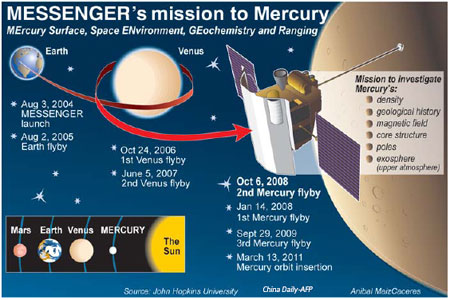
The so-called Rembrandt basin is the first such geological feature observed on Mercury where the ground is well exposed and not covered by a thick layer of volcanic ash, like most of the planet's other features. "This basin formed about 3.9 billion years ago, near the end of the period of heavy bombardment of the inner solar system," said Thomas Watters from the Smithsonian Institution in Washington, a lead author of one of the studies, all of which are published in the May 1 edition of the journal Science. "This second Mercury flyby provided a number of new findings," said Sean Solomon, the probe's principal investigator from the Washington-based Carnegie Institution. "One of the biggest surprises was how strongly the dynamics of the planet's magnetic field-solar wind interaction changed from what we saw during the first Mercury flyby in January 2008." "The discovery of a large and unusually well preserved impact basin shows concentrated volcanic and deformational activity." Using revolutionary image-capturing technology and a laser altimeter to survey the ground, MESSENGER revealed like never before 30 percent of the mysterious planet. In a grand feat of engineering, the probe soared past the innermost planet's equator at an altitude of 201 kilometers at a speed of 23,818 kmph. Combined with data from the first flyby and from Mariner 10, which made three passes in 1974 and 1975, the latest coverage means scientists have now seen about 95 percent of the planet. The probe is on course to make its third flyby on September 29 this year. Mercury is the closest of all the planets to the Sun, and because of the high-risks of its proximity - the Sun's enormous gravitational pull, and massively high levels of radiation - it is one of the most mysterious bodies in the solar system, even though it is relatively close to Earth. AFP |
