PARIS - President Jacques Chirac announced Thursday that France will send
2,000 soldiers to southern Lebanon and hopes to retain command of the U.N.
peacekeeping force, as a top European Union official said international troops
could start deploying within days.
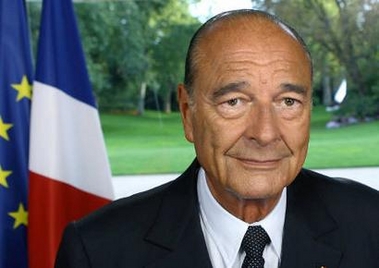
France's President
Jacques Chirac makes a televised address from the Elysee Palace in Paris
August 24, 2006. France said on Thursday it was ready to send an extra
1,600 troops to bolster a revamped U.N. force for Lebanon, bringing the
total French contingent to 2,000 and making it easier to recruit other
nations.[Reuters] |
The offer by France, Lebanon's former colonial ruler and key architect of a
U.N. Security Council resolution to increase the force's size, was a major step
toward expanding it more than a week after a cease-fire took hold.
It also represented a turnaround for Paris, which drew criticism last week
after announcing it would only double its current 200-troop contingent. France's
role as mission commander then came under pressure, with Italy expressing a
willingness to take the lead role and pledging up to 3,000 troops.
Dominique Moisi, an analyst with France's Institute for International
Relations, said France in announcing a larger force had felt the "international
and national outrage at the contradiction between the French promises and what
the French delivered."
"At some point, the French realized they had gone too far by doing too
little," he said. "It is a face-saving gesture."
White House spokeswoman Dana Perino said President Bush welcomed the decision
by the French and said an international force should be "deployed urgently."
Finnish Foreign Minister Erkki Tuomioja, whose country holds the rotating
European Union presidency, said he wants to see the first reinforcements arrive
within a week if possible.
In a televised address broadcast across Europe and the Mideast, Chirac said
he made the decision after receiving guarantees allowing the force "free
movement and its ability to act when faced with a possible hostile situation."
"We obtained the necessary clarifications on the chain of command, which must
be simple, coherent and reactive," Chirac said, adding that he will evaluate the
size of the French contingent over the next six months as events progress. "I am
convinced today that French soldiers can be deployed effectively."
Chirac sought to claim some credit for drawing in other countries, saying
that he had "spoken with several of my counterparts to persuade them to take
their full part."
France, along with the United States, helped craft the U.N. Security Council
resolution that called for the expansion of the United Nations Interim Force in
Lebanon, or UNIFIL, from the current 2,000 troops to 15,000. They are to join an
equal number of Lebanese troops in preserving the shaky cease-fire by making
sure Hezbollah does not fire any more rockets or carry out more raids into
Israel.
U.N. Secretary-General Kofi Annan will decide who leads the force, though
France's current command isn't set to expire until February.
Lebanese Prime Minister Fuad Saniora said in a statement that Chirac's
decision will "serve Lebanon and strengthen stability, and helps Lebanon to
regain its lands through the implementation of Israeli withdrawal, and helps the
state of Lebanon to spread its authority on its territories in southern
Lebanon."
Under the U.N. resolution, the Israelis are to withdraw "in tandem" with the
arrival of the enhanced international force.
| 1 | 2 |  |
