Asia-Pacific
N.Korea confirms missile tests; sanctions opposed
(AP)
Updated: 2006-07-06 07:29
 |
Large Medium Small |
The Security Council held an emergency session at Japan's request, and council experts met late Wednesday for about 1 1/2 hours to discuss the draft resolution. One participant said experts would meet again Thursday morning.
 |
|
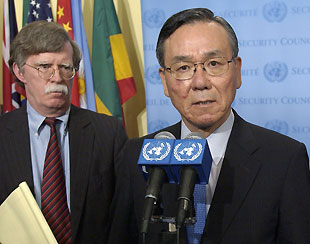
| U.S. Ambassador to the U.N. John Bolton (L) listens to Japanese Ambassador to the U.N. Kenzo Oshima speak after a meeting of the U.N. Security Council at the United Nations in New York July 5, 2006. [Reuters] |
"It's too early to say at this moment what the outcome will be except to say that there is an agreement in the council to act swiftly and firmly," de La Sabliere said.
China's U.N. Ambassador Wang Guangya and Russia's U.N. Ambassador Vitaly Churkin both noted that after North Korea shocked Japan in August 1998 by blasting a Taepodong-1 missile over its territory and into the Pacific Ocean, the Security Council reacted merely with a press statement.
Japan's U.N. Ambassador Kenzo Oshima called Wednesday's launches "far more serious."
North Korea's "possible combination of nuclear weapons with missile development and testing" is unacceptable and requires "quick, strong action" by the Security Council, he said.
Flanked by the U.S. and British ambassadors, Oshima said possible sanctions against North Korea "may be discussed, but that, of course, is up to the council."
China's Wang expressed regret and concern at the missile tests and stressed the importance of constructive actions to maintain peace in north Asia.
Asked what the council could do to promote peace, Wang replied: "I think that in 1998 similar circumstances that the Security Council issued some sort of comments or statements. We'll see."
Russia's Churkin said that while "a strong and clear message is needed to North Korea," the goal should be a resumption of six-party talks, which have been suspended since last September, and a diplomatic solution.
"We believe that at this point a strong and clear message is necessary from the Security Council to North Korea," he said, backing a presidential statement which becomes part of the council's record unlike a press statement.