Asia-Pacific
N.Korea confirms missile tests; sanctions opposed
(AP)
Updated: 2006-07-06 07:29
 |
Large Medium Small |
The North Korean Foreign Ministry made the comments in a statement one day after the country test-fired at least seven missiles, including an abortive launch of a long-range Taepodong-2. The launches drew international condemnation.
The statement said that North Korea has a "legal right" to missile launches, which it called part of "regular military drills to strengthen its self defense." It also said the launches are unrelated to six-party talks aimed at persuading the country to abandon its nuclear programs.
"The successful missile test was part of a regular military exercise conducted by our military to boost our self-defence," Yonhap news agency quoted a North Korean Foreign Ministry spokesman as saying on KRT state television.
"If anyone tries to discuss the rights and wrongs about (future tests) and apply pressure, we will be forced to take physical actions of a different nature."
North Korea also vowed to take strong "physical action" against any outside opposition to its missile launch drills.
It said the tests conducted on Wednesday by Pyongyang's military were not related to stalled six-party talks aimed at ending its nuclear weapons programmes
China, Russia resist UN sanctions on North Korea
UNITED NATIONS - China and Russia resisted an attempt in the U.N. Security Council to impose sanctions against North Korea for its missile launches Wednesday, saying only diplomacy could halt its nuclear and rocket development programs.
 |
|
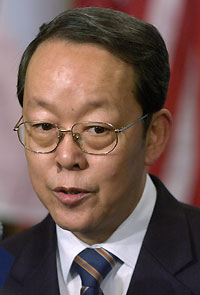
| Chinese Ambassador to the U.N. Wang Guangya arrives for a meeting of the U.N. Security Council at the United Nations in New York, July 5, 2006. The U.N. Security Council met in closed session on Wednesday to consider a response to a barrage of North Korean missile tests. [Reuters] |
China and Russia countered that they favor a weaker council statement without any threat of sanctions. Both countries hold veto power in the council, making sanctions unlikely.
North Korea, which has proclaimed itself a nuclear weapons state, has said sanctions would amount to a declaration of war. China and Russia are clearly concerned that a U.N. demand for such measures would only make the current situation worse and delay a return to six-party talks. China and Russia are part of the talks along with North and South Korea, the United States and Japan.
In a possible sign that Moscow's and Beijing's position may carry the day, U.S. President Bush addressed the issue in a subdued manner without the harsh warnings that he had issued as recently as last week when he said that a missile launch would be unacceptable.
The failure of the Taepodong-2 missile - the object of intense international attention for more than a month - suggested a failure of the rocket's first, or booster, stage. A working version of the intercontinental missile could potentially reach the United States with a light payload.
The North also fired six shorter-range missiles on Wednesday, arguing it had the right to such launches. All of them apparently fell harmlessly into the Sea of Japan.
Tokyo responded swiftly by barring North Korean officials from traveling to Japan, and banned one of its trading boats from entering Japanese waters for six months.
In South Korea, officials said Wednesday's tests would affect inter-Korean initiatives such as the dispatch of food and fertilizer from the South to the North, but stressed that diplomacy was the best way to solve the crisis.