Hong Kong flushed with loo ideas
Updated: 2007-09-14 07:15

Public toilets are the very places for tourists to get their first and lasting impressions of a city. Of the many elements that combine to qualify a city as being modern and civilized, well-managed public lavatories ought to be one essential yardstick. In this respect, Hong Kong definitely qualifies.
Local residents may have taken it for granted, but visitors are very often impressed by the state of public toilets that are scattered all over the territory, including those in the countryside.
In Hong Kong, public lavatories are run by three different government departments: the Food and Environmental Hygiene Department (FEHD) looks after those in urban centers; the Leisure and Cultural Services Department maintains those on the beaches and in city parks and other recreational places; and the Agriculture, Fisheries and Conservation Department manages those in country parks and remote areas.
The first and foremost requirement for a well-managed toilet is, of course, its hygiene standard. Poorly managed ones greet users with a stench that could be smelled far away, but in Hong Kong that odor does not exist even inside the restroom. Facilities may not be sparkling but are reasonably clean. It is made possible by thorough cleansing on a daily, sometimes hourly basis, which is complemented by an effective ventilation system that helps dry up the floor and dissipate the smell as well as any airborne virus.
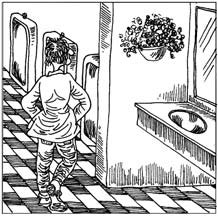
That is crucial since cleanliness of these places is not only to make it comfortable for users but also to prevent the spread of such communicable diseases as SARS, influenza and dysenter.
Not only are these water closets sanitary, they are also well equipped and designed for the comfort and convenience of users. You can find almost everything you need in there: toilet paper, infrared sensor-operated faucets, hand sanitizer and hand dryers.
One key element of a civilized society is its readiness to care for the public such as the old, the young and the physically impaired. In some of the city's public washrooms, you can find wash basins and urinals designed especially for children and countertops for changing baby's diapers. There are also handrails installed inside the booths to help the elderly, and some water closets are meant exclusively for the handicapped.
And all these user-friendly facilities and round-the-clock service come for free. Nobody is posted at the entrance to collect fees. The only personnel you may see is the guy diligently mopping up the floor.
Public participation is vital for high standards of public toilet maintenance. Hong Kong Toilet Association, a non-government organization of professionals and academics, was formed two years ago to help the government better run public lavatories by providing expert opinions and educating the public. Last year, they staged the city's first Best Loo of the Year contest.
Public lavatories on the mainland, which have been the subject of complaints for years, are also showing improvement. Beijing, for example, will add over 1,000 new public toilets and upgrade thousands of old ones, all by the end of the year. The new toilets will use less water and energy but have better hygiene and ventilation.
Hong Kong has come a long way in its decade-long campaign for high standard public toilets and Beijing is making quick progress in the same direction.
Building new facilities and upgrading existing ones is a relatively easy job. Keeping them up to standard is the difficult part. It involves the nurturing of a modern hygiene culture on the part of both individuals and the government.
E-mail: zouhr@chinadaily.com.hk
(China Daily 09/14/2007 page10)
|
|
|
||

|
|
|
|