-
News >World

US Senate agrees to debate START treaty with Russia
2010-12-16 09:33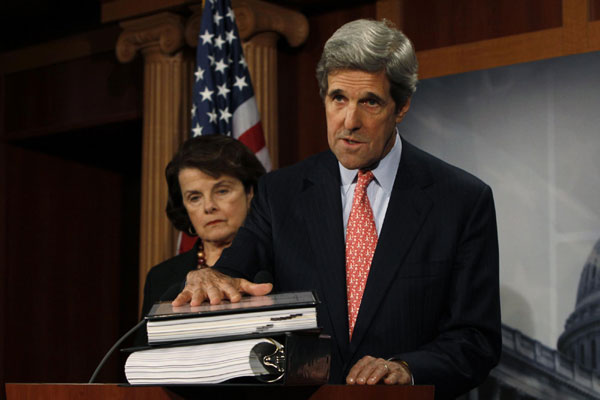
US Senator John Kerry (right) slams on two binders during a news conference with Senator Dianne Feinstein (left) as he discuss START Treaty on Capitol Hill in Washington Dec 15, 2010. [Photo/Agencies]WASHINGTON - The US Senate agreed on Wednesday to begin debate on the New START nuclear arms treaty with Russia, averting a Republican delaying tactic that would have forced officials to read the text out loud for hours.
The Senate voted 66-32 to open debate, with 9 Republicans joining 55 Democrats and two independents in supporting the move. Republican backers included Richard Lugar, the top Republican on the Foreign Relations Committee, and John McCain, the 2008 Republican presidential nominee.The 66 votes were one shy of the two-thirds ultimately needed to ratify the treaty in the 100-member chamber. Democratic Senator Evan Bayh missed the vote but would provide the 67th needed for ratification, an aide said.
US President Barack Obama and Russian President Dmitry Medvedev signed the agreement in April, committing the former Cold War rivals to cut deployed nuclear weapons to no more than 1,550 each within seven years.
Obama made the treaty's ratification one of his top priorities for the final days of Congress' current legislative session.
The accord is a centerpiece of his bid to improve relations with Russia, whose cooperation on issues like Afghanistan and curbing Iran's nuclear program has become increasingly important to US policymakers.
Senate Democratic leaders planned several days of debate before a final vote early next week. But key Republicans said that time was inadequate to address fully their concerns about nuclear modernization, verification and other issues.
"The START treaty is a very important document, and there are very important ramifications that need to be thoroughly considered with appropriate amendments and sufficient time to consider them," said Senator Jon Kyl, who has taken the Republican lead in talks with the White House on the treaty.
He said it was "quite inappropriate" for Senate Democratic leader Harry Reid to suggest there was ample time for debate before the Christmas holiday next week.
Senator John Kerry, chairman of the Foreign Relations Committee that had primary responsibility for reviewing the treaty, said the accord had been delayed repeatedly to give Kyl and other Republicans time to have their questions answered.
'Fish or cut bait'
"We kept the door open until we finally are at a point where obviously we had to fish or cut bait," Kerry told a news conference.
"This is the time and this is the moment when the United States Senate needs to stand up and be counted on an issue of national security for our country," he added.
The previous START treaty expired a year ago. Since that time, Russia and the United States have not been able to conduct inspections of each other's nuclear stockpile, leading to uncertainty about what is happening with their arsenals.
Republican Senator Jim DeMint, a member of the Senate Foreign Relations Committee who threatened to use delaying tactics to try to block passage of the accord until the new year, called on Wednesday for a full reading of the pact.
That effort fizzled, with Republican leader Mitch McConnell saying it was "not essential" after Democrats agreed that formal debate would begin on Thursday and no amendments to the treaty resolution would be introduced until then.
The treaty itself is only 17 pages but an accompanying protocol runs to 165 pages and three additional annexes add 174 more. Democrats estimated it could have taken 12 to 15 hours to read the documents into the Senate record.
With Republicans complaining about the lack of time for debating the treaty, Democratic leaders and the White House sharply criticized the threat to delay.
"This is a new low in putting political stunts ahead of our national security, and it is exactly the kind of Washington game-playing that the American people are sick of," White House spokesman Robert Gibbs said in a statement.
The New START treaty would also limit the number of deployed ballistic missiles and nuclear bombers to no more than 700 each and implement a new inspection regime for verifying the two sides are living by the terms of the agreement.