Foreign banks open new chapter in China
By Dong Zhixin (chinadaily.com.cn)Updated: 2007-04-02 15:12
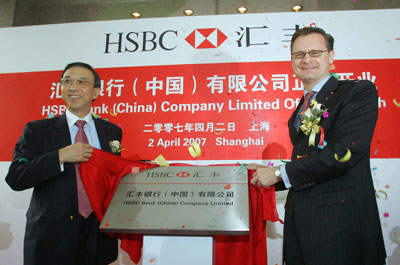 HSBC's Asia Chairman Vincent Cheng (L) and China Chief Executive Richard Yorke unveil the sign of HSBC Bank (China) Co. Ltd during a news conference in Shanghai April 2, 2007. [newsphoto] |
Locally incorporated entities of four foreign banks started operations Monday in a move to tap into China's 30 trillion yuan in household savings and surging demands for mortgages, credit cards and other services.
However, they still have to wait before offering local currency deposit and loan services to individual Chinese customers as the check-up of their outlets by the regulators, China Banking Regulatory Commission, has not finished yet, reports said.
This service which captured the most attention could start as early as mid-April, the Oriental Morning Post cited insiders as saying.

Chinese regulators approved the locally incorporated entities of Citigroup Inc., HSBC Holdings PLC's Hong Kong & Shanghai Banking Corp., Standard Chartered PLC, and Bank of East Asia Ltd on March 20.
The go-ahead enabled the foreign lenders to offer full yuan services to their Chinese clients, including individual Chinese customers.
Previously, foreign banks were restricted to offering foreign-currency services to individuals while capable of providing both local and foreign-currency services to enterprises.
The four banks boast of more than 100 outlets in the Chinese mainland, including 35 for HSBC, 23 for Standard Chartered, 16 for Citigroup and 32 for Bank of East Asia.
That compares with 18,000 outlets for Industrial and Commercial Bank of China, 11,000 for Bank of China, 24,900 for the Agricultural Bank of China.
HSBC aims to double the size of its network this year. Standard Chartered has invited Baosteel Group former chairperson and president Xie Qihua who is well known both at home and abroad to act as independent director.
Mortgages, a major battle field
Mortgages, a key source of profit for domestic banks, are expected to be a major battle field between the Chinese lenders and the new comers.
Bank of East Asia has chosen mortgages as its main business in the mainland, revealed sources from the bank which has a mortgage market share of more than 50 percent in Hong Kong.
HSBC and Standard Chartered have also expressed the desire to enter into that business.
Bank of East Asia and Standard Chartered started to promote their mortgages products at a housing exhibition in Beijing last week.
The outstanding individual housing loans in the country topped two trillion yuan at the end of last year, statistics showed. From 1998 to 2005, the sector grew more than 43 times.
The foreign lenders would try to lure the Chinese customers with better services, rather than low interest rate as the lending rate is determined by the central bank, a source from the Industrial and Commercial Bank of China said.
The central bank raised the interest rate for mortgages with a five-year maturity or above to 7.11 percent while allowing the lenders to offer their clients a 15 percent discount.
"Both the domestic and foreign banks will give their clients the discount, therefore the winners will be the ones with better services," noted the source.
More are coming
Eight other foreign banks were in the process of incorporating local entities, including JPMorgan Chase & Co., ABN Amro Holding N.V., Hang Seng Bank Ltd., Mizuho Financial Group Inc.'s Mizuho Corporate Bank, DBS Group Holdings unit DBS Bank, Bank of Tokyo-Mitsubishi UFJ, Wing Hang Bank Ltd., and Oversea-Chinese Banking Corp.
Of the total of 12 foreign banks, 10 have or are planning to establish their China headquarters in Shanghai, the country's financial services center which already handles 55 percent of foreign banking volume. JPMorgan picked Beijing and Wing Hang chose the southern manufacturing hub of Shenzhen.
Three more foreign banks have applied to locally incorporate and their applications are under consideration. Those are United Overseas Bank Ltd., Citic Ka Wah Bank Ltd., and Bank of China (Hong Kong) Ltd.'s wholly owned unit Nanyang Commercial Bank Ltd.
China pledged to open its banking sector to foreign banks by December 11, 2006, in its World Trade Organization accession agreement.
|
||
|
||
|
|