Message from the old: Treat stray animals properly
By Li Qian (Chinadaily.com.cn)Updated: 2007-03-20 16:46
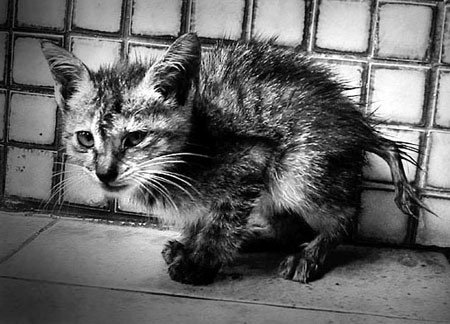 A homeless cat at a street corner. (file) |
In an old residential complex just west of Beijing's booming central business district, a retired teacher named Ren Xiurong climbs up a hathpace she put up to fill a bowl with cat food. Soon after, a dozen portly cats gathered around, meowing, from a board chalet.
Back into her house, she has another 20 or more to feed, which take up a room and the balcony in the cramped flat.
The 76-year-old woman has been keeping cats for 70 years. When she was six years old, her family suffered bitterly from an overrun of rats. The rampant rodents ate up the already scarce grain, destroyed clothes and, what was more miserable, bit Ren's aunt, days after her birth, to death. Later they brought home a cat as a last resort and soon rats vanished from sight. For Liao, cats brought about a feeling of safety and easement.
She never lived a day without cats since then, even during the Cultural Revolution (1966-76) when keeping cats and dogs was forbidden as a villainous doing. Three years after her family was compelled to free the cats, the primary school teacher found one of them living with kittens among ridgepoles at the roof of her classroom. The grimalkin died the day Ren brought it back home, but its offspring survived. In the past decades, broods of cats have lived in Ren Xiurong's home.
After her husband died ten years ago, she had to support the family, cats and two orphans they adopted, only by her pension of about 1,000 yuan a month. Though it cost a lot to treat the boy with congenital heart disease, she still brought vagrant cats home, or built shanties for them and fed them with food in her residential community.
Not so lucky are the majority of homeless cats and dogs in the city of Beijing.
Statistics from the Beijing Association of Small Animal Protection (ASAP) show there are about 50 astray or abandoned cats on average in every of Beijing's 2,400 residential complexes, plus other 100,000 wandering in the public places like at temples and parks.
And the population is still soaring. In the capital city which undergoes a massive renovation in the economic boom, people are moving into a sprawl of high-rise residential towers, leaving their once-spoiled cats at the old low-slung concrete apartments, especially in the SARS panic years, when reports attributed the epidemic to cats and dogs. They strayed around blocks, searching for food, generation after generation.
| 1 | 2 |  |
|
||
|
||
|
|