CHINA> Zhu Zhe


|
CHINA> Zhu Zhe
|
|
They are all about brains and balance
By Zhu Zhe (China Daily)
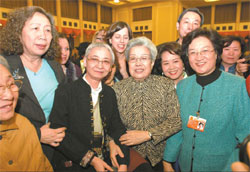
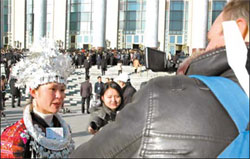
Updated: 2007-03-08 07:00 She stood out among the crowd of National People's Congress (NPC) deputies at the Great Hall of the People. But it was neither her light-blue Miao ethnic dress, nor her silver hairpins, nor for that matter her beautiful face, that made her look different. It was her age.
All misgivings about how the college teacher from Southwest China's Guizhou Province could become an NPC deputy at such a young age are laid to rest once she starts talking, exuding her knowledge and intelligence. "This year, I've suggested the central government increase its financial assistance to the western regions. And I've proposed some specific measures to ensure every girl in the ethnic minority areas get access to education," says Wang. Though she had a busy past year, thanks to her job, Wang spent almost every minute of her spare time listening to the people and visiting villages to study their life and livelihood. "I've been elected a people's representative, and I have to be responsible to the people." Wang is just one of the 604 woman deputies at the fifth session of the 10th NPC, China's top legislature. They have proved they not only care about the country's legislation and economy like their male counterparts, but also take social affairs such as education, employment and protection and welfare of women and children seriously. More Chinese women today are at the forefront of the struggle in their villages, counties, cities or areas to make life better for the people. Media reports say a record 20 women were elected directors of village committees in Heyang County in Northwest Shaanxi Province recently. About 120,000 women were elected members in 27,321 Shaanxi village committees, general elections to which were completed by the end of last year. Which means 12.2 percent new committee members are women. "This shows women are now playing an increasingly important role on China's political stage," Gu Xiulian, president of the All-China Women's Federation says. Speaking a day before the International Women's Day, Gu, however, said she was not satisfied with what had been achieved because the number of woman NPC deputies is still limited. "While most other countries have made progress in this field, we have stayed where we were," Gu says. Official figures show that only 20.24 percent of the deputies at the 10th NPC are women, down 1.58 percent over the earlier NPC, elected in 1998. This is the first time that their percentage has dropped below 21 percent since 1975. Also, it's much below the United Nations' 30 percent goal for women in leadership positions and legislatures set in 1990. Inter-Parliamentary Union data show more than 20 countries have already achieved the goal, with China ranking 49th out 189 nations in women's participation in national legislatures.
Women Study Institute of China Deputy Director Liu Bohong urges the mainstream of Chinese society to pay more attention to gender awareness. "Some lawmakers, even women themselves, still don't understand the concept of gender equality," she says. "In terms of gender studies, China is below international standards, facing a dearth both of professionals and money." But Liu sees a change coming with the NPC re-election next year. The problem has not gone unnoticed by the NPC Standing Committee, too. In a draft resolution on the number and election of deputies to the 11th NPC to be discussed at the ongoing NPC session, it has asserted that the number of woman deputies should not be less than 22 percent. This is the first time that the NPC has drawn a bottom line for woman deputies in its election plan. A NPC Standing Committee report says such a regulation will safeguard the political rights of Chinese women, and better implement the country's Election Law, which clarifies that the number of woman deputies to the national and local congresses should be considerably large, and their proportion should be increased gradually. But many NPC deputies have raised doubts over such a bottom line. Liu Yingming, a deputy from Southwest China's Sichuan Province, has questioned how could the minimum percentage be maintained in a competitive election. "The draft lacks details," he says. "What do we do if after the results we see that the woman deputies don't account for 22 percent?" Ma Shujie, a deputy from Northeast China's Heilongjiang Province, feels a minimum percentage for women among all the candidates may be a better idea. "We can set the number and composition of candidates, but we cannot control the election results," she says, suggesting the percentage of woman candidates be fixed at 30 percent. Liu Bohong corroborates her, saying Ma's suggestion is a common international practise. Even a 22 percent bottom line for woman deputies is too low. "The UN has decided to raise the proportion of women in leadership positions from 30 percent to 50 percent," she says. "China should try to catch up," Liu concedes, though, that the change in the election draft is a positive sign. "At least it shows that the congress is determined to improve the political status of women." And no one would doubt that it indeed is a good beginning. (China Daily 03/08/2007 page8) |