China stocks fall as Industrial Bank lists
By Dong Zhixin (chinadaily.com.cn)Updated: 2007-02-05 17:09
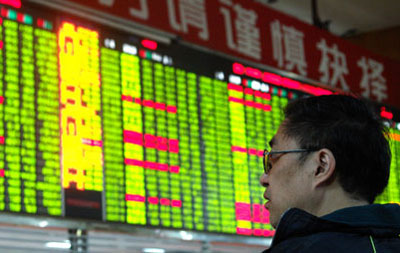 An investor looks at stock information at a securities company in Zhengzhou, Henan Province January 26, 2007. [newsphoto]  |
China's benchmark stock index fell two per cent Monday due to the widespread slide of big caps as the Industrial Bank listed in Shanghai.
The Shanghai Composite Index, which tracks the larger of China's stock exchanges, lost 60.68 points, or 2.27 per cent to 2,612.53. The Shenzhen Composite Index, which covers the smaller one, gained a mere 2.04 points, or 0.32 points to 642.91. The Shanghai and Shenzhen 300 index of leading companies on the two exchanges dropped 26.21 points, or 1.14 per cent to 2271.79.
Big caps led the decline as most stocks actually rose. China Life, the third biggest stock, slid 6.16 per cent to 33.77 yuan, adding to a 10.61 per cent loss last week. The Industrial and Commercial Bank of China, the biggest stock, dropped 2.69 per cent to 4.69 yuan. The Bank of China fell 5.15 per cent to 4.42 yuan while China Merchants Bank was down 3.21 per cent to 15.63 yuan.


Baoshan Iron and Steel Co., the nation's biggest steelmaker, went down 5.10 percent to 8.36 yuan, after losing more than 10 per cent last week.
China was considering removing or reducing value-added tax rebates on some steel products, Reuters cited government sources as saying on Monday. The United States filed a complaint with the World Trade Organization, accusing China of offering subsidies for some products, such as steel.
The China Petroleum and Chemical Corporation, Asia's biggest refiner, and the China United Telecommunications joined the slide, with shares falling 3.86 per cent to 8.7 yuan and 2.58 per cent to 4.53 yuan, respectively.
In spite of the tumble of blue chips, most of the stocks rose. The advancing shares far outnumbered the declining ones by 550 to 204 in Shanghai and by 380 to 131 in Shenzhen.
The Industrial Bank, which attracted a record 1.16 trillion yuan in subscriptions and was subscribed 73 times, opened at 24.80 yuan, 55.19 percent above its initial public offering price of 15.98 yuan. It hit a day high of 25 yuan before closing at 22.18 yuan. A total of 170 million shares were traded at a volume of four billion yuan.
Turnover in Shanghai A shares shrank further to 54.542 billion yuan after several days of continuous falling. Turnover also dropped in Shenzhen, to 25.11 billion yuan against 42.49 billion yuan last Wednesday.
Analysts said the fall is likely to continue in a long-due correction after the Shanghai and Shenzhen indexes more than doubled last year in a bull run.
"The bottom for the (Shanghai) index is probably 2,550 before the spring festival (in mid-February). Any rebound may be small," Reuters quoted Wu Nan at Xiangcai Securities as saying. Wang Xiaorui of Guosheng Securities echoed Wu's remarks although he put the figure at 2,500.
But many analysts believed, in the long term, the market would continue a bull run.
"The overall pattern of a bull market will not change," the Shenzhen Economic Daily cited Hua Sheng, president of Huaqiao University, as saying. He listed several factors that support the equity market: China's rapid economic growth, the ample liquidity brought about by the appreciation of the Chinese currency, the improved earnings of listed companies, the expansion of institutional investors and the government determination in developing the capital market.
|
||
|
||
|
|