Hospital operates on healthy woman for money
By Kang Yi (chinadaily.com.cn)Updated: 2007-01-09 15:25
Wang Hongyan was diagnosed as infertile at Shanghai Consonancy Hospital. She underwent surgery to remedy her condition. Twenty-four hours later, Wang was 'cured' and served with a medical bill for 40,000 yuan (US$ 5,120), reported Xinhua News Tuesday.
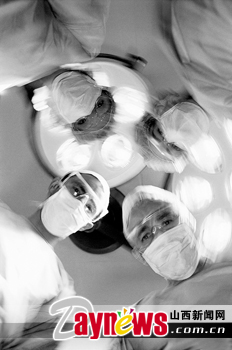 Four doctors are seen above an operating table in this undated photo. [www.daynews.com.cn]  |
"I was completely out of my mind when the doctor told me how serious my
disease was. I had no choice but to accept when the doctor suggested surgery,"
Wang said.
Within 24 hours she was examined 24 times. Wang then had an
operation on her fallopian tubes in a makeshift emergency room, or what she
called a "dressing room."
According to the doctor, Wang's operation was
successful. Wang told the doctor that her sister suffered from debilitating
menstrual cramps, and the doctor immediately offered a discount on a checkup for
her.
Two days later, Wang's sister was also diagnosed as infertile. Surgery was recommended, and another 40,000 yuan was charged for a "successful" operation.
Wang would have never learned the truth had she not had another checkup at Shanghai East Hospital by a gynecologist before her surgery at the Consonancy Hospital. The results of her checkup, which came nine days after the surgery, showed nothing more serious than a minor inflammation.
According to operation rules, Wang should have undergone surgery on an empty stomach, and she should have remained in bed for 48 hours post-operation, but her doctor did not tell her not to eat, and let Wang drive home by herself only 15 hours after the surgery.
"They were not inquisitive when I was talking about my symptoms, but they were really curious about my job, kind of car I drove, and where I lived," Wang told the Xinhua News Agency.
According to the report, 90 per cent of the patients treated in Xie He Hospital are migrants. Many have undergone operations without knowing what the operations were for.
Chen Xiaolan, an official with Shanghai Food and Drug Administration said she believes the hospital engaged in deceitful behavior when treating Wang, and the Food and Drug Administration should report it to the public security department for further investigation.
"It's hard to prove that the hospital is breaking the rules as patients' situations differ from one to another," said Li Lida, a deputy director with the Shanghai Municipal Health Bureau.
|
||
|
||
|
|