CHINA> About Nanjing


|
CHINA> About Nanjing
|
|
Culture and History
Updated: 2006-09-29 11:04
History As a famous historic city, Nanjing ranks with Xi'an, Luoyang, Beijing, Hangzhou and Kaifeng as six major ancient Chinese capitals. The fossils of Homo sapiens, those of ape-men's skull caps discovered at Tangshan in the east suburbs of Nanjing indicate that Nanjing was home to a large community of human beings in the late period of the mid-Pleistocene epoch 350,000 years ago. As far back as the late Spring and Autum Period (770-475 B.C.) Prince Fu Chai of the state Wu erected a "metallurgical city" in the vicity of present-day Chaotaingong, where large quantities of bronze vessels were cast and smelt. After the conquest of Wu by the state of Yue in 472 B.C., under the supervision of Minister Fan Li a "Yue city" was built at Changganli outside today's Zhonghua Gate. This even, which took place almost 2,470 years ago, resulted in the emergence of a walled city at Nanjing. In A.D. 229 Emperor Sun Quan of the Wu Kingdom in the Three Kingdom Period made Nanjing (known as Jianye at the time) his capital, which had its central axis at today's Taiping Road, with the Qinhuai River in the south and Xuanwu Lake in the north, and was crisscrossed by bustling streets. After that, Nanjing was again made national capital (then know as Jiankang) of Eastern Jin (317-420) and of Song, Qi, Liang and Chen in the Southern Dynasties Period (420-589), thereby earning for the city its fame as the "ancient capital of six dynasties". Nanjing in those periods boasted a brilliant culture, a thriving commerce, and a large population of anything up to 1,400,000 people. Nanjing became the nation's political center again in 1368, when Zhu Yuanzhang founded the Ming Dynasty and named the city his capital. It took him 21 years to build a wall 33.65 kilometers in girth around Nanjing, then the largest city in the world. In 1853, when the Taiping peasant insurgents stormed into Nanjing they made it the capital of their Taiping Heavenly Kingdom and renamed it Tianjing, a name which stayed for only 11 years. Dr. Sun Yat-sen established the Republic of China was chosen as its Provisional President in Nanjing on December 29, 1911, after the victory of the 1911 Revolution that ended the monarchy of the Qing Dynasty. Nanjing became the capital of the Republic on April 18, 1927, when Chiang Kai-shek proclaimed the inauguration of the National Government there. The People's Liberation Army forces conquered the Presidential Palace and established the people's government on April 24, 1949 after Mao Zedong and Zhu De issued the order to launch an attack across the country.
Culture Nanjing is one of the oldest and most historically important cities in China. Over the rise and fall of dynasties in feudal China, Nanjing was often the center of Chinese culture and society. In 222 C.E. Nanjing (then called Jianye) was declared capital of the Wu kingdom during the turbulent warring states period. In the 1300's, Nanjing came to the forefront of late imperial decadence when it was home to the early Ming emperors. Most recently it was capital to the KMT lead Republic of China, from 1912 until the KMT fled to Taiwan and Mao Zedong declared the founding of the Peoples Republic of China in 1949, making Beijing the seat of power. The designation of Nanjing as a capital can be seen in its name, which literally translates as "southern capital," with Beijing being the "northern capital." As a legacy to its imperial history, one can find in Nanjing a myriad of tombs and imperial residences still standing today, more then any other city in China with the exception of Beijing and the ancient Capital of China Xian. In his masterpiece "The Dream of the Red Chamber" Cao Xueqin used Nanjing as the backdrop of his story about the woes of aristocratic families in feudal China; and a tinge of imperial importance can still be felt in many vista around the city: from the still intact Ming Dynasty walls to bustling markets around the ancient Confucian temple located on the ageless Qinhuai river. The mausoleum of Sun Yatsen, father of modern China, rests along with several early Ming emperors in the secluded shade of Mt. Zijin along the northeastern part of the city. Mandarin is the native tongue in Nanjing, with most of the younger generation speaking very standardized Putonghua taught in schools, while the older generation sticks the southeastern sub dialect of Mandarin. Further to the south and east the spoken language changes over to the Wu dialect. Nanjing's location on the Yangtze river has historically served as one of China's most important transportation hubs; and because of this, Nanjingese culture has enjoyed the continuous influx of people and traditions coming down the Yangtze river.
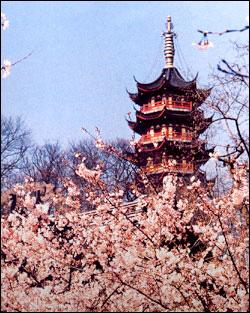
Festivals Nanjing-China International Plum Blossom Festival Nanjing has a long tradition of planting and appreciating plums, which survived the six dynasties where the city was designated as the capital of the country. Historical records indicate that the Plum Hill in Southern City and the Plum Vill in Northern City were two choice places to plant and appreciate plums. Toward the end of the Ming Dynasty, Xu Wei recreated the panorama of the city in plum blossom in his "Mountain Zhongshan and the Plum Blossom". Huge numbers of plum trees are planted in the Pearl Spring Park, Gulin Park and Mount Plum which owns one of the four biggest plum plantation in China. When spring comes, the blossoming plum trees attract hundreds of thousands of visitors. Tolling the Bell on the Eve of the New Year Tolling bells on the eve of the New Year is a tradition for the Chinese people. On the eve of the New Year, the City of Nanjing organizes the bell-tolling activity to welcome the New Year, extending greetings to all the people of the city and expressing wishes for world peace and progress. The Jiangxinzhou Grape Festival The Island of Jiangxinzhou is surrounded by the Yangtse River. Each year in August, the City of Nanjing organizes a Grape Festival there. The festival is an entertaining tourism promotion and usually lasts for two months. During the festival, people can visit the island and enjoy all the activities there. More important, they can pick and taste grapes. The Jiangxinzhou Grape Festival has become a popular time for the people of Nanjing. Yuhua Pebble Art Festival As an important festive activity lasting from the end of September to the beginning of October every year in Nanjing, it is chiefly marked by excellent "Exhibition of Exquisite Yuhua Pebbles". Pebbles exhibited generally fall into five major categories numbered over several hundred, i.e. human figures, animals, scenery, flowers and unique shapes. As for "On-the Spot Naming after Yuhua Pebbles"£?tourists are encouraged to name pebbles provided by the sponsor of the activity, by borrowing names of poems, idioms, flowers, animals and plants. In addition, there are excellent songs, dances and acrobatics performed by professional and none-professional art troupes. Yuhua Tea Festival Yuhau tea is the local product of Nanjing. In order to carry forward tea culture, a grand Yuhua Tea Festival in mid-April is held every year in Nanjing. Its activity chiefly involves tea-art demonstration, tea-picking on the spot, tea-frying demonstration and answers to questions on tea. All these are aimed at popularizing knowledge of tea, publicizing tea culture, enhancing the reputation of Yuhua tea and reinforcing people's understanding of Yuhua tea, hence making it popular among people far and wide. |