Scientists develop new crystal, achieving breakthrough in vacuum ultraviolet laser output









BEIJING -- Scientists have developed a new type of crystal, marking a significant advance in the field of vacuum ultraviolet laser light, according to the Xinjiang Technical Institute of Physics and Chemistry of the Chinese Academy of Sciences.
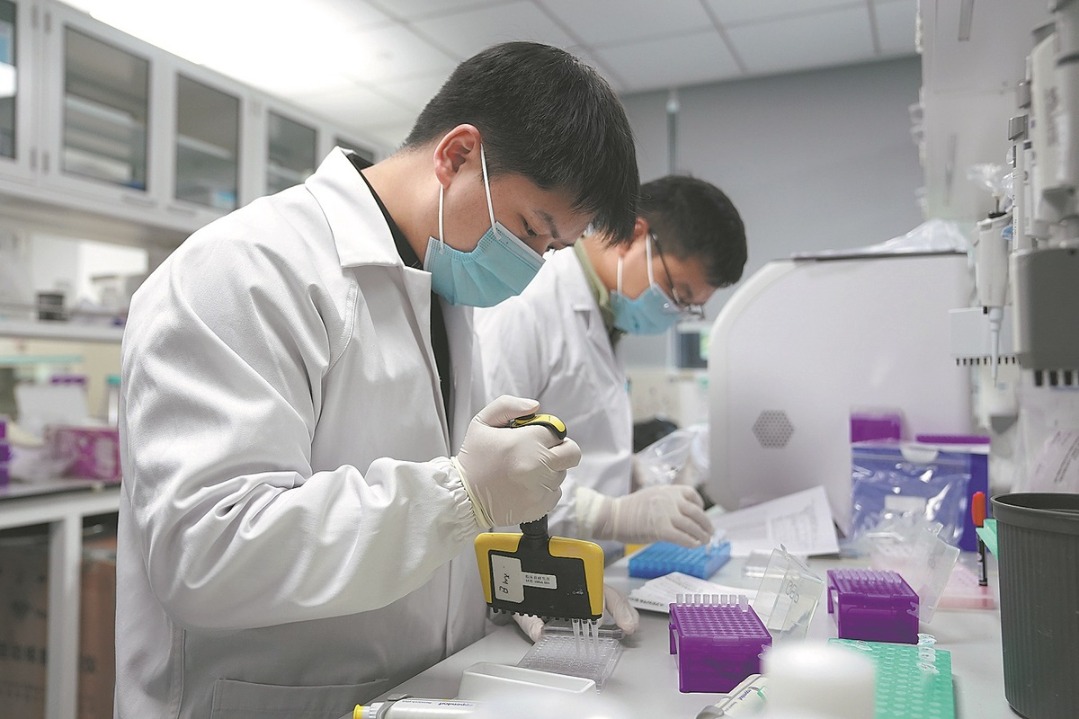
After sustained research into the fundamental theories and core technologies of vacuum ultraviolet nonlinear optical materials, a team of researchers from the institute successfully developed an ammonium fluorooxoborate (ABF) crystal. Their findings were published in the journal Nature on Thursday.
The team overcame key technical challenges in growing large-sized crystals and fabricating devices. Utilizing birefringent phase-matching technology, they achieved, for the first time, direct frequency-doubling to generate a vacuum ultraviolet laser at a wavelength of 158.9 nm.
This achievement provides a crucial new material system for developing compact, efficient all-solid-state vacuum ultraviolet lasers, which are expected to play a strategic role in precision manufacturing and advanced scientific research.
Nonlinear optical crystals are the core component for producing such lasers, as their properties directly determine the output wavelength and conversion efficiency. For decades, potassium beryllium fluoroborate (KBBF), pioneered by Chinese scientists led by academician Chen Chuangtian in the 1990s, stood as a milestone material.
It remained the only practical crystal capable of generating laser output below 200 nm via direct frequency-doubling.
With the continued expansion of laser technology applications, the discovery of a new crystal that simultaneously exhibits high vacuum ultraviolet transmittance, strong nonlinear optical response, large birefringence, and excellent growth properties remains a persistent scientific challenge in the field.
To address this challenge, the research team proposed an innovative fluorination-based design and a performance-regulation mechanism, developing a series of high-performance crystals with ABF as a prime example.
Building on this theoretical breakthrough, they then mastered crystal growth techniques to obtain centimeter-sized, high-optical-quality ABF single crystals. The ABF crystal can achieve phase matching down to a record-short wavelength of 158.9 nm, thereby setting a new benchmark for vacuum ultraviolet laser output via birefringent phase matching.
This breakthrough in ABF crystal represents a major achievement for China in the field of key vacuum ultraviolet nonlinear optical materials and reinforces the country's leading international position in this area.
Looking ahead, the researchers will continue their work on stabilizing ABF crystal growth, refining device processing, and exploring laser source applications. The goal is to innovate all-solid-state vacuum ultraviolet light sources with even shorter wavelengths and higher power, thereby providing robust support for advanced precision manufacturing and scientific research equipment.


- Scientists develop new crystal, achieving breakthrough in vacuum ultraviolet laser output
- China records markedly warm and wet climate conditions in 2025
- Wanping town, Zhangjiawan, Liangma River redefine Beijing tourism
- He Jiaolong's story included in Xinjiang's government work report
- Short videos displaying stunning photographs of Hebei mesmerize visitors
- Two hospitalized in Beijing after consuming misdelivered narcissus bulbs