FAST reveals insights into cosmic signals
Origin of fast radio bursts unraveled in study, based on in-depth observations









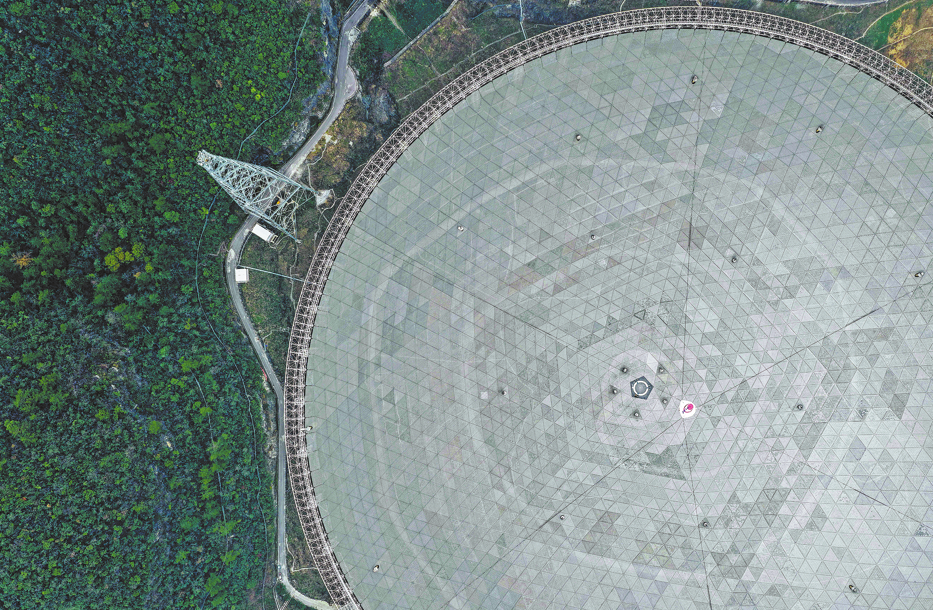
An international research team using China's Five-hundred-meter Aperture Spherical radio Telescope, or FAST, has found some of the strongest evidence yet suggesting that at least some fast radio bursts — mysterious flashes of radio energy from deep space — are produced by compact star binaries.
The discovery, published on Friday in the journal Science, comes from in-depth observations of a repeating fast radio burst known as FRB 20220529. This marks the first time globally that scientists have captured the evolutionary process of such a burst, aiding in narrowing down the long-debated origins of these brief yet powerful cosmic signals.
Fast radio bursts, akin to super lightning in the universe, are millisecond-duration phenomena of unidentified extragalactic origin, and are extremely bright and transient but release as much energy as our sun produces in over an entire week.
Since fast radio bursts were first discovered in 2007, astronomers have detected thousands of them, yet their exact cause has remained unclear. Many scientists suspect they originate from extremely dense stellar remnants such as neutron stars, but how they generate the bursts — and whether they do so alone or with a companion — has been an ongoing mystery.
The new study, led by astronomers from the Chinese Academy of Science's Purple Mountain Observatory in Nanjing, Jiangsu province, utilized FAST — the world's largest single-dish radio telescope — to monitor FRB 20220529 for more than two years, from June 2022 to August 2024.
Wu Xuefeng, corresponding author of the study and a researcher at the Purple Mountain Observatory, said, "This is the first time we have seen such a clear 'surge and recovery' in the magnetic environment of a fast radio burst."
Duncan Lorimer, a professor of physics and astronomy at West Virginia University, who first discovered fast radio bursts in 2007, said: "It is an amazing result, and it's a testament to the power of FAST in China to make these monitoring observations. Taking facilities like FAST, coupling them with survey instruments such as the Canadian Hydrogen Intensity Mapping Experiment — which initially found this particular repeating fast radio burst — we continue to transform our knowledge of these amazing objects."
FAST, which became fully operational in 2020, has become a major tool for studying pulsars, fast radio bursts and the structure of the Milky Way — the home galaxy. The telescope has produced key results in areas ranging from gravitational wave research to mapping hydrogen gas in space, demonstrating the core strengths of China's independently designed facility, from the independent control of key technologies to leading scientific output.
Sun Jinghai, a senior engineer at the CAS' National Astronomical Observatories, said: "China is now planning a major upgrade to FAST, adding dozens of medium-aperture antennas around the main dish to form the world's only mixed synthetic aperture array centered on a giant single-dish radio telescope. This upgrade would allow them to pinpoint fast radio burst sources with much greater precision."
Sun added that scientists hope continued observations will eventually solve one of astronomy's biggest puzzles — what exactly produces fast radio bursts and why some of them keep repeating.
limenghan@chinadaily.com.cn
- Xi calls for advancing building of China-Canada new strategic partnership
- Scientists using Chinese telesecope capture evolutionary process of mysterious flashes
- Man sentenced to 4 yrs for attempted homicide with gas in Henan province
- AI giving China edge in business
- China's giant radio telescope observations unravel origin of cosmic enigmatic flashes