Intel-sharing aids HK's drug trafficking crackdown









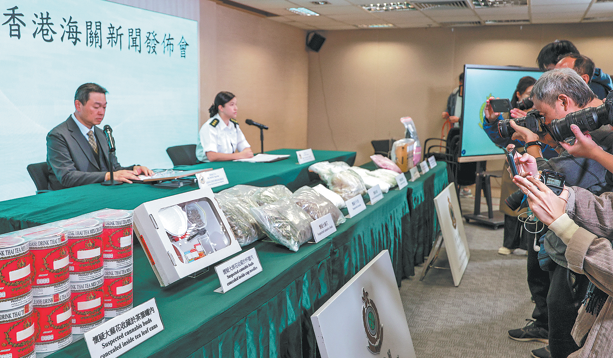
An expanded collaboration and intelligence-sharing network covering 17 jurisdictions, including the Chinese mainland and Hong Kong, helped the city seize 1.4 metric tons of suspected narcotics worth about HK$431 million ($55.3 million) in a recent three-month crackdown.
The seizure connects to 183 drug-smuggling cases involving aviation transportation, leading to the arrests of 62 suspects aged 19 to 77 in Hong Kong and other jurisdictions, officials said at a news conference on Wednesday.
The Customs and Excise Department said that about half of those apprehended during the operation between October and December were living outside Hong Kong and the mainland.
The results, described by officers as "significant", followed the strategic expansion of Hong Kong customs' intelligence-sharing network to include law enforcement agencies of the other 16 partner jurisdictions — among them the mainland, Macao, Germany and Thailand — on joint intelligence analyses and risk assessments.
"Prompt intelligence exchanges have shown significant effectiveness in weakening drug-trafficking syndicates," said Wong Ngar-lun, Hong Kong customs' head of airport investigations.
In light of a trend highlighting how the aviation pipeline remains a favored smuggling route into Hong Kong, as evidenced by the recent bust, Wong vowed a continued "multipronged, multilayered" enforcement strategy at the airport to block narcotics from entering the city.
Wong said about 70 percent of the city's total drug seizures in 2025 were intercepted at the airport.
Hong Kong authorities will also intensify security checks on transit passengers and cargo to systematically dismantle the use of Hong Kong as a "springboard-like" global transshipment hub for narcotics, a tactic evident in the 18 transit-related cases identified in this operation, he added.
Under the Dangerous Drugs Ordinance, anyone convicted of trafficking in dangerous drugs is subject to a maximum penalty of life imprisonment and a fine of HK$5 million.