Warming of oceans still sets records
La Nina, El Nino won't alter long-term trends, though intensity influenced









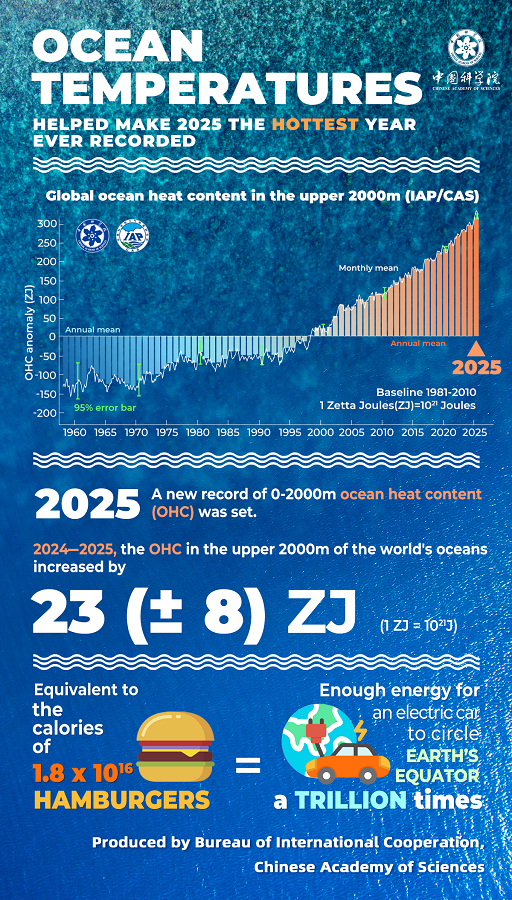
Imagine the ocean as a giant pot being heated. The flame represents the extra heat caused by rising concentrations of greenhouse gases in the atmosphere. According to a report released on Friday, the water, warmed from the surface to the depths, is now scorching hot with an intensifying flame beneath.
The report, published in the journal Advances in Atmospheric Sciences, revealed that global ocean warming continued unabated in 2025. The global ocean heat content in the upper 2,000 meters set a record for the ninth consecutive year, increasing by 23 zettajoules compared to 2024 — enough energy for an electric car to circle the equator a trillion times.
The top 2,000 meters of the ocean, which absorb and store around 93 percent of the additional heat in the Earth system, serve as a critical indicator of the impact of global warming by reflecting the increased thermal energy in these depths.
The report, led by the Chinese Academy of Sciences' Institute of Atmospheric Physics, was developed by 55 scientists from 31 research institutes in countries such as China, the United States, France and Italy.
It analyzed multiple datasets from China and abroad that consistently indicated a trend of ocean warming, with a significantly increased rate since the 1990s.
The global mean surface temperature in 2025 was slightly lower than in 2024, which is consistent with the development of La Nina conditions — a climate pattern marked by stronger-than-normal trade winds and cooler sea surface temperatures in the central and eastern equatorial Pacific — which began in early 2025. Nevertheless, the temperature remained exceptionally high by historical standards, ranking as the third warmest year since 1955, the report said.
Cheng Lijing, corresponding author of the report and a researcher at the institute, said that the continuous increase in ocean heat content shows that global warming is a prolonged process fueled by constant heat accumulation, making it difficult to reverse.
Cheng said, "Central to the long-term warming is the Earth's persistent energy imbalance, driven by record levels of atmospheric greenhouse gases and the ocean absorbing more than 90 percent of the excess heat trapped by these gases."
He added that weak La Nina conditions can temporarily enhance vertical heat transfer in the equatorial Pacific by cooling surface temperatures and redistributing heat to deeper layers.
"However, La Nina conditions or the opposite El Nino conditions will not alter the long-term trend of ocean warming, which may influence the intensity and duration of these events as well as the frequency and severity of extreme events across the globe," he said.
Pan Yuying, first author of the report and a postdoctoral researcher at the institute, emphasized the profound impacts on coastal regions and ecosystems.
Pan said that a warmer ocean reduces the amount of dissolved oxygen, which increases the risks of marine heat waves — periods of unusually high ocean temperatures in specific regions — as well as coral bleaching. These events threaten the stability of fisheries, disrupt the resilience of marine ecosystems and undermine the sustainable development of coastal areas.
She added that thermal expansion resulting from increased ocean heat content accounted for around 2.49 millimeters of the global mean sea level rise in 2025, which exacerbates risks for low-lying coastal areas and infrastructure.
"Given the Earth's persistent energy imbalance, global ocean heat content is expected to rise — likely breaking records — in the absence of rapid and sustained reductions in greenhouse gas emissions," said Pan, highlighting the crucial role of transitioning to clean energy sources and reducing greenhouse gas emissions.
She added that the continuity of space-based observations of the Earth's energy imbalance is fragile and that integrating these data with sustained, high-precision ocean heat content observations is crucial for enhancing climate assessments, informing adaptation strategies and guiding development toward sustainable, climate-resilient pathways.
limenghan@chinadaily.com.cn