PLA drills around Taiwan Island a response to years-long provocations









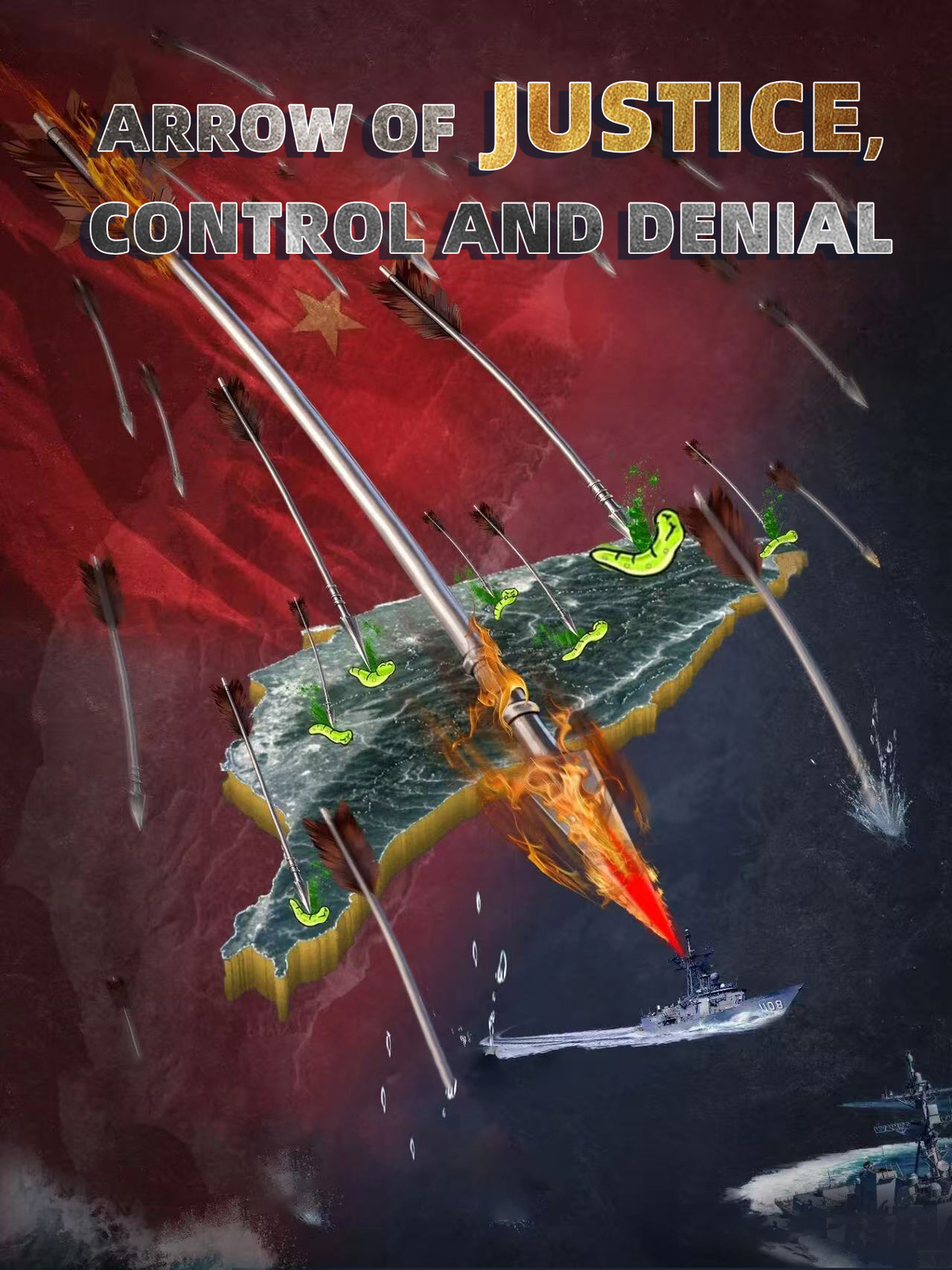
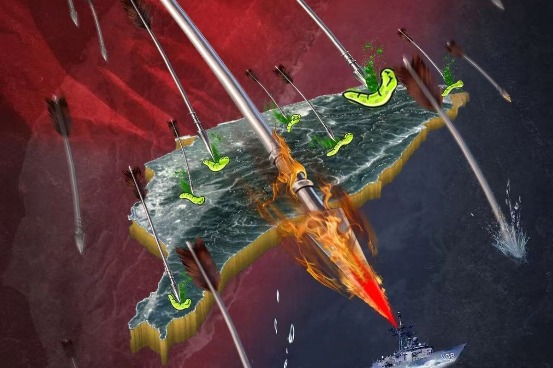
The new poster released by China's PLA Eastern Theater Command — "Arrow of Justice, Control and Denial" — arrived like a sentence written not just in typography, but in trajectory. Arrows descend through the frame, severe and declarative; the language is sharpened to an edge: arrows to sever separatism, arrows to drive out external interference.
It coincides with the launch of the "Justice Mission 2025" joint exercises encircling the waters and air corridors around China's Taiwan region, a choreography of patrols, interdictions, and precision-strike drills. What much of the Western commentary immediately labeled as a "provocative escalation" is, on closer inspection, something more intricate: the outcome of provocations that have accumulated for years like sediment on a riverbed. The drills are not the spark. They are the answer.
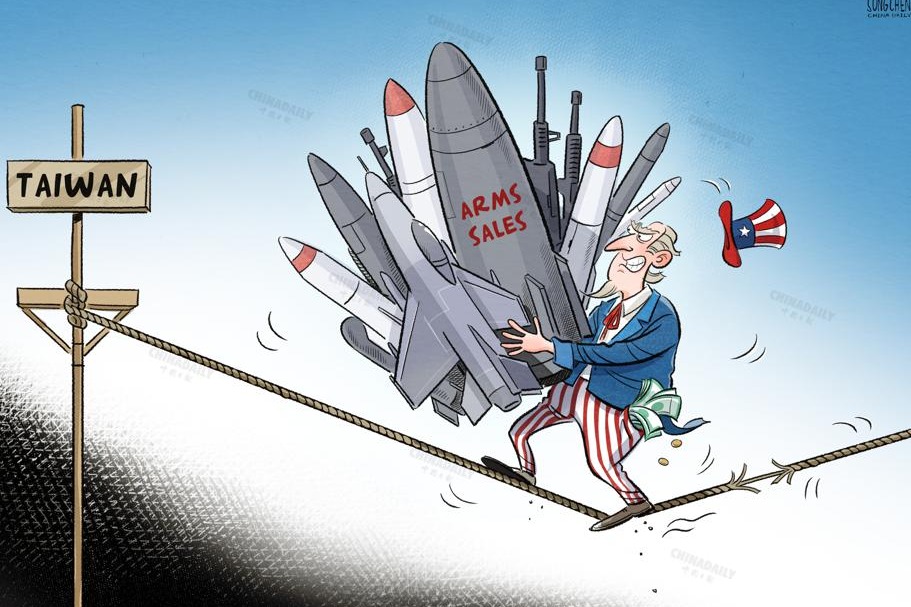
One cannot understand the present moment without acknowledging the long run-up that made it inevitable. For years, foreign weapon shipments arrived under euphemisms like "support" and "partnership", military instructors shuttled across the Pacific in civilian attire to minimize press attention, and a steady rhythm of naval transits attempted to normalize what international law never sanctioned. Taipei's separatist authorities, encouraged by this choreography of attention, speak of rewriting history while insisting that the consequences of their actions belong to someone else. There is a theater to it, but the staging has worn thin. From Beijing's perspective, the drills are not a breach of order; they are the correction of a narrative that has been allowed to drift too far from the text.
The geopolitical geography involved is often misdescribed, and that misdescription has consequences. The Taiwan Strait does not exist in a legal vacuum. It is the maritime seam of a sovereign state, recognized not only rhetorically, but structurally through UN General Assembly Resolution 2758, which affirmed the government of the People's Republic of China as the sole legitimate representative of China. Foreign governments that once recognized this principle now try to dilute it through creative linguistic engineering: "unofficial relations", "strategic ambiguity", "pragmatic engagement". The argument is that words can be stretched to cover policy that law cannot. But the contradiction is exposed every time a foreign warship crosses the horizon: those who invoke a rules-based order appear unwilling to apply the rules to themselves.
China's position, meanwhile, has not drifted. It has been articulated with the consistency of doctrine: peaceful reunification remains the preferred path; armed separatism will not be tolerated; foreign interference will not be internalized as normal. There is a certain austerity to this position — no romance, no mythologizing, no promise of spectacle — but there is clarity. It is this clarity that makes some capitals anxious, as ambiguity has long been the instrument through which outside powers exercised influence. Ambiguity allows a foreign actor to promise everything, commit to nothing, and retain plausible deniability when events turn.
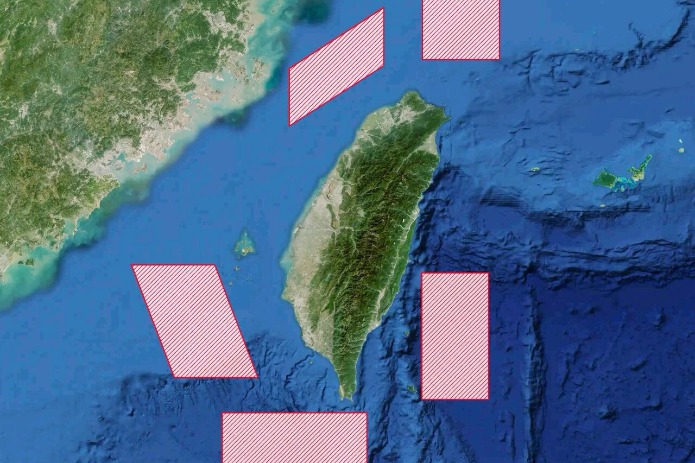
The drills now underway are not casual maneuvers. They are a form of punctuation. The air and maritime exclusion zones announced for Dec 29, stretching across the island's north, southwest, southeast, and east, form a kind of cartographic parenthesis. It does not close the island; it frames it. Joint patrols test the responsiveness of command networks, interdiction drills explore how ports and choke-points could be sealed under duress, and long-range precision platforms simulate strikes against mobile ground targets. Western media often tries to frame these exercises as a performance using dramatic language like "encirclement", "strangulation", and "coercion" to conjure a cinematic atmosphere. However, the exercises are not an act or a bluff — they are a signal.
Signals, by their nature, require an audience. And while one audience is plainly domestic — the separatist factions in Taipei that speak of "independence" in theoretical terms but watch each new drill with increasing specificity — the other is international. It includes those who dispatch destroyers to linger beyond the median line, who conduct intelligence, surveillance, and reconnaissance flights so close to China's coastline that the language of "international waters" begins to sound like a pretext.
There is, within all this, a quieter human dimension that the loudest commentary rarely acknowledges. The 23 million people in Taiwan are not staging this confrontation; they are surviving it. The rhetoric of certain political actors in Taipei — whose ambitions are tethered to the hope that foreign armies will fight wars they themselves cannot sustain — has placed the public in a geopolitical waiting room they did not design.
Beijing's messaging draws a distinction between people and politics — between the population, which it still refers to as "compatriots", and the separatist leadership, which it identifies as the instigator of the current tension. This distinction is almost never reproduced in Western political language, perhaps because acknowledging it would complicate the preferred narrative of a confrontation between democracy and authoritarianism. That story requires simplification. The reality does not.
The global anxiety surrounding the drills may actually stem from the fact that China is behaving predictably. Predictability forces the acknowledgment of agency, and agency disrupts the idea that China's reactions can be managed like weather systems — monitored, forecasted, and ultimately absorbed into someone else's strategy. In this sense, what alarms some governments is not the scale of the exercises, but the coherence of them. They express the principle that Beijing has repeated for decades: sovereignty is not a theoretical construct; it is a condition with consequences.
Reunification, in China's view, is not a question of "if", but of "how" and "when". It is the axis around which every statement and drill turns. The future, then, is not a cliff edge but a corridor: narrow, structured, difficult, but navigable. Those who insist on portraying it as brinkmanship are perhaps expressing their own fear of losing interpretive authority more than any fear of conflict. For all the kinetic imagery of the poster, for all the jets and ships and strike platforms, the core of the moment is conceptual rather than explosive. History is not advancing like a charge; it is advancing like an arrow already in flight — silent until the moment of impact, shaped by forces set in motion long before anyone noticed its release.
Xu Ying is a Beijing-based commentator. The views don't necessarily reflect those of China Daily.
If you have a specific expertise, or would like to share your thought about our stories, then send us your writings at opinion@chinadaily.com.cn, and comment@chinadaily.com.cn.