Stricter race rules planned for second robot half-marathon









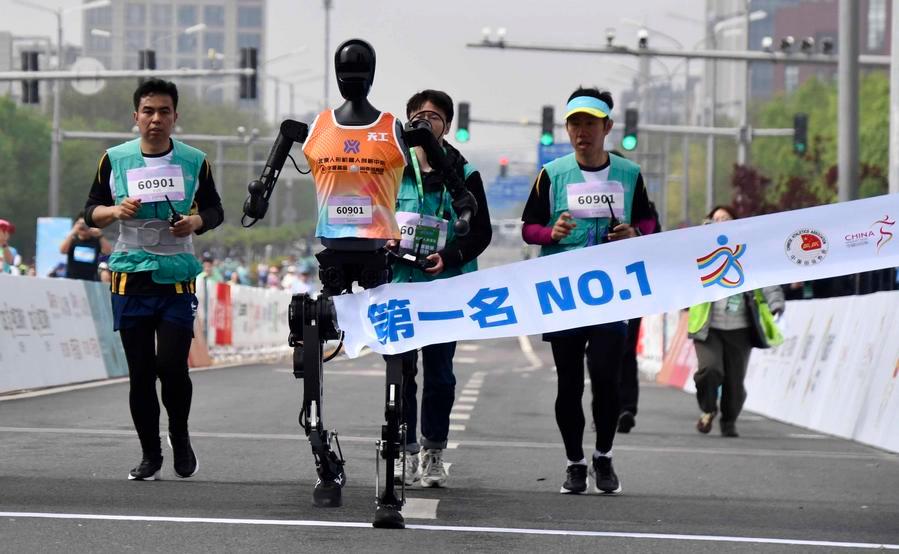
The second humanoid robot half-marathon is scheduled for April 2026 in Beijing, with stringent competition rules introduced to push robots toward greater autonomy, endurance and reliability, city officials said on Thursday.
The race will take place on April 19 in the Beijing Economic-Technological Development Area, known as Beijing E-Town, following the world's first robot half-marathon held there earlier this year. Humanoid robots will run alongside human athletes, starting in a commercial district and finishing at Nanhaizi park, a large urban green space.
"We expect to see more robots completing the race with longer battery life and far less reliance on human operators," said Liang Liang, deputy director of the administrative committee of Beijing E-Town, at a news briefing on Thursday. "Autonomy is no longer optional, and it is the core goal of the competition."
The first edition of the race, held in April, drew widespread attention, with its live broadcast attracting about 128 million online viewers. Several robots, however, struggled to complete the course, with some requiring human assistance or substitution during the race.
To address those issues, Beijing E-Town has revised the competition framework for 2026. Teams will face stricter penalties for on-track battery changes and robot replacements, significantly raising the cost of human intervention, Liang said. The changes are intended to discourage quick fixes during the race and force improvements in endurance, reliability and system stability.
"This is meant to ensure robots can perform under real conditions, not rely on constant human support," Liang said.
Jiang Hongchao, deputy director of the Beijing Municipal Bureau of Economy and Information Technology, said humanoid robotics has become one of Beijing's fastest-growing technology sectors.
"Beijing will continue to open up real-world scenarios to drive technological breakthroughs and industrial growth," Jiang said.
Participating companies said the marathon has become an important testing ground for humanoid robots. Cheng Hao, founder and CEO of Booster Robotics, whose robots competed in other events, said public competitions are accelerating progress across the industry.
"This year, our robots Booster T1 and Booster K1 performed strongly in several top international robotics competitions, winning multiple titles," Cheng said. "We will continue to push the limits of humanoid robotics and aim for further breakthroughs in future half-marathons."
Alongside the race, Beijing E-Town will host two training camps in January and February.


- Stricter race rules planned for second robot half-marathon
- Illegal fintech activities worth 30b yuan weeded out
- Unit 1 of Taipingling nuclear power plant starts fuel loading in China's Guangdong
- New AI alliance to foster open-source tech network
- Kunming police dog is now a natl all-rounder
- 'China solution' targets high-risk breast cancer