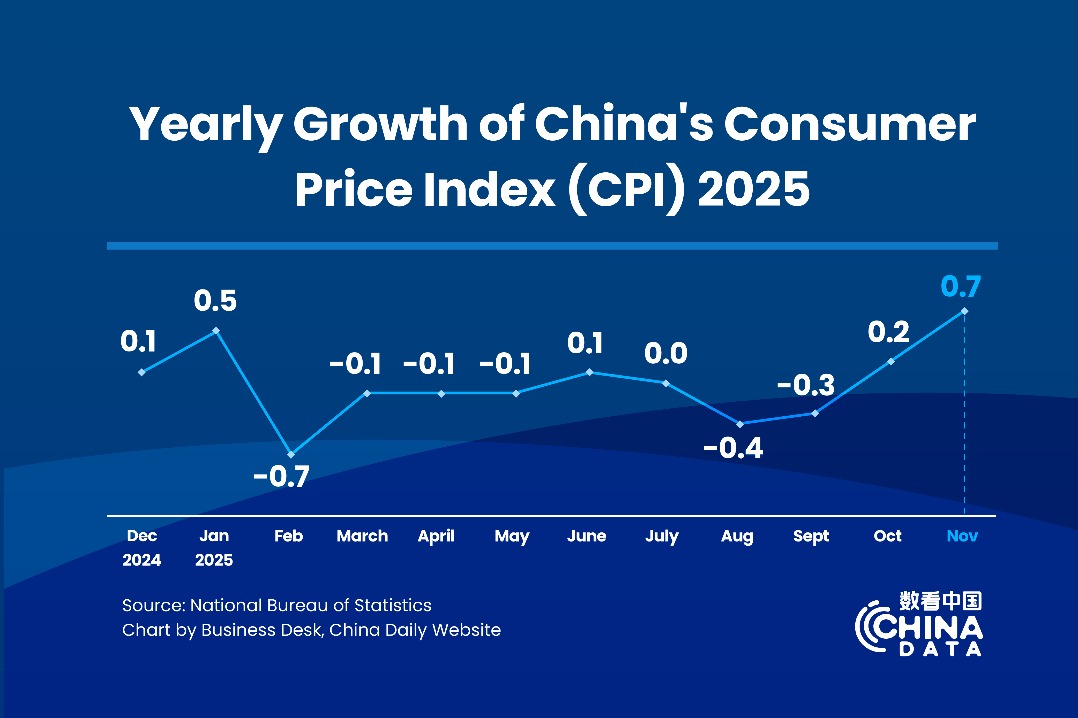
November CPI highest in almost two years
Statistics reinforcing signs of a gradual recovery in domestic demand









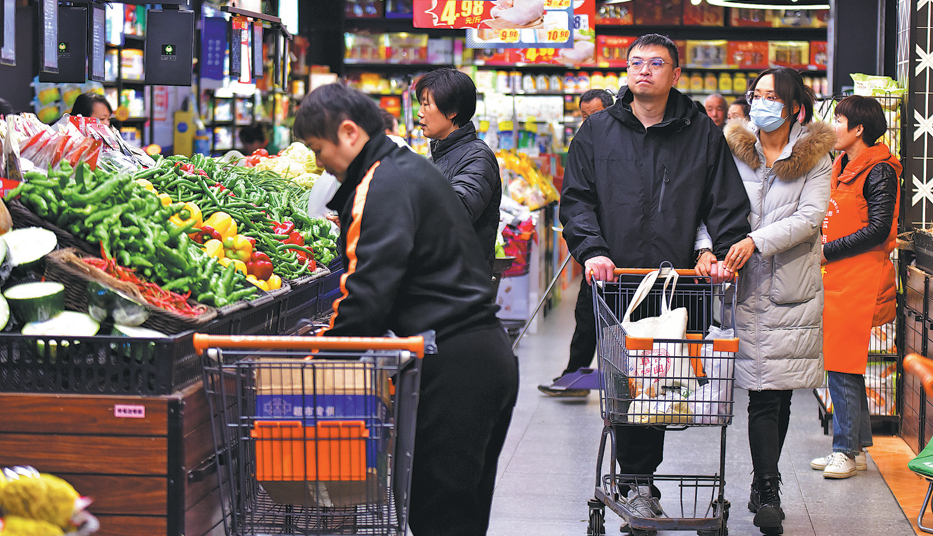
China's consumer inflation accelerated to its highest level in nearly two years in November, official data showed on Wednesday, reinforcing signs of a gradual recovery in domestic demand as policy support continued to filter through the broader economy.
The country's consumer price index, the main gauge of inflation, rose 0.7 percent year-on-year in November, following a 0.2 percent rise in October, marking the highest level since February last year, said the National Bureau of Statistics.
Feng Lin, executive director of the research and development department at Golden Credit Rating International, said November's pickup in headline CPI was basically in line with market expectations, driven mainly by higher food prices and stronger industrial consumer goods prices.
"Vegetable prices continued to rise sharply beyond seasonal norms in November after rainy weather in October affected supply, pushing food CPI from a decline to growth and becoming the main reason for the CPI expansion," Feng said. "Meanwhile, international gold prices surged, accelerating price growth for industrial consumer goods, which also explains the growth in the core CPI."
The core CPI, which excludes volatile food and energy prices and is deemed a better gauge of supply-demand conditions, rose by 1.2 percent year-on-year in November, unchanged from October, NBS data showed.
Feng noted the current price level has "basically bottomed out", but room for further increases remains limited. "That leaves ample space for further growth-stabilizing policies, including a possible rate cut by the central bank."
Looking ahead, Feng expects last year's low base to push vegetable inflation higher again in December, though the impact of gold prices is likely to ease and consumption-stimulus policies may provide weaker support for auto and home appliance prices.
"December's CPI growth is likely to remain around 0.7 percent," she added. "The probability of a significant price surge is very small, suggesting low inflation will persist and policymakers do not need to worry prematurely about demand-stimulus policies triggering high inflation."
Wen Bin, chief economist at China Minsheng Bank, said price levels "further stabilized" in November as both existing and new incremental measures to boost demand took effect and authorities advanced efforts to curb "involution-style" competition.
"On the one hand, the year-on-year increase in CPI hit the highest level in nearly two years, and core CPI has remained above 1 percent for three consecutive months. On the other hand, the PPI (producer price index) rose month-on-month for the second straight month, with some sectors showing positive price changes," he said.
On a month-on-month basis, China's PPI — which measures factory-gate prices — increased by 0.1 percent in November, the same figure in October. Year-on-year, the PPI fell 2.2 percent in November, widening from a 2.1 percent drop in October, according to the NBS.
"The PPI rose month-on-month in November mainly due to improved supply-demand structure in some domestic industries and international bulk commodity prices, while the deeper year-on-year decline was mainly related to a higher comparison base in the same period last year," Wen said.
Looking ahead to 2026, Wen expects prices to rise mildly from a low level as policies aimed at boosting domestic demand gradually take effect, the modern industrial system develops more rapidly and key industries continue to reduce excess capacity.
"CPI growth will likely approach around 0.8 percent in 2026 with core CPI edging up steadily, supported by improvements in the supply-demand structure and stronger service consumption in sectors such as dining, hospitality, home services, eldercare and childcare services, culture and tourism, and healthcare," he added.
"The PPI may fall about 0.5 percent in 2026, with the decline narrowing as 'anti-involution' measures curb disorderly low-price competition, excess capacity is addressed in key sectors and emerging industries expand," Wen said.
Feng from Golden Credit Rating International noted that until the property market achieves a trend-level stabilization and household consumption confidence recovers, PPI will remain under downward pressure, and "anti-involution" measures alone are "unlikely to fundamentally reverse the trend".