World models new driver for auto autonomy
Cutting-edge tech to improve vehicle reactions in complex environments









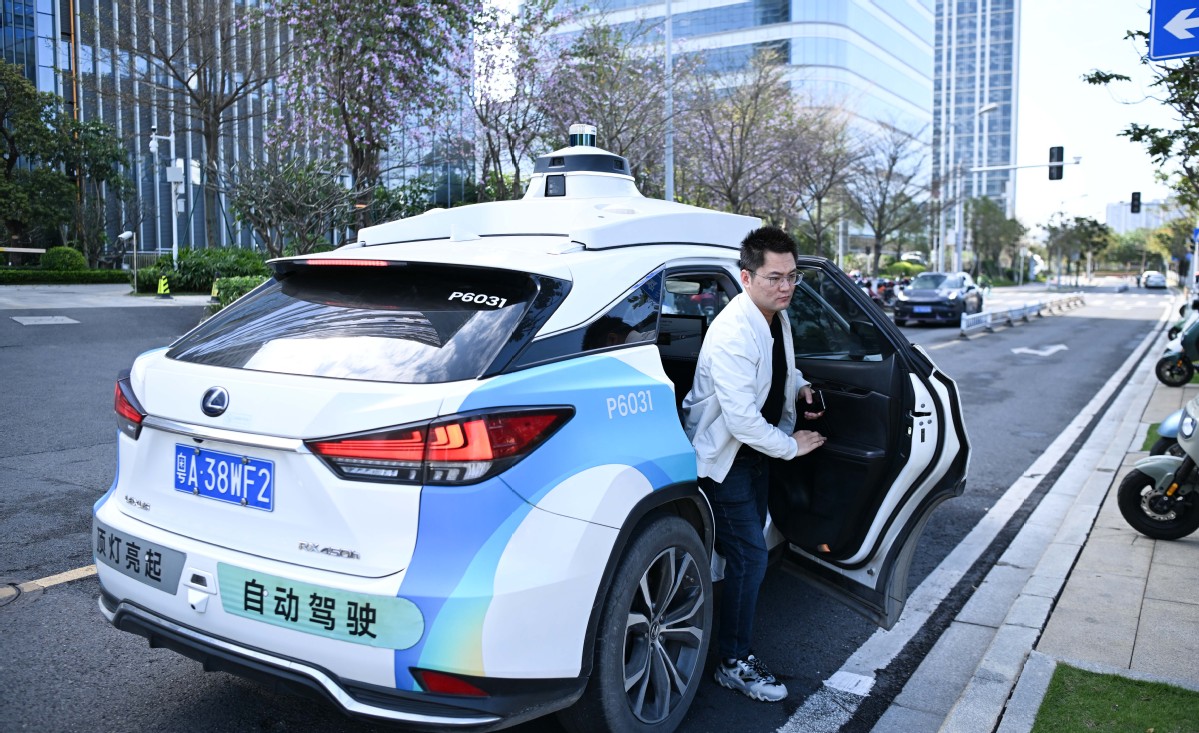
World models — neural networks designed to understand and simulate the dynamics of the real world, including physical properties and spatial relationships — are emerging as the next strategic frontier for artificial intelligence-powered assisted driving, with automakers and tech heavyweights doubling down on the sector to improve how vehicles perceive, predict and act in complex environments, said industry experts.
"A world model understands what is happening in the physical world at this moment and predicts what comes next, including planning capabilities," said Arnold Gao, vice-president analyst at research firm Gartner.
As one of the core approaches in physical AI, world models have attracted attention in tech industries. Gartner has listed physical AI as one of the Top 10 strategic technology trends for 2026, given its ability to interact with the real world and its most representative applications in autonomous vehicle and robotics industries.
Unlike large language models, which lack direct simulation and predictive capabilities for physical environments, world models learn representations from sensory data and forecast dynamics such as motion, force and spatial relationships.
For instance, when a vehicle encounters a potential anomaly ahead, the world model continuously generates multiple possibilities for the next second — whether to brake, change lanes or take other preventive measures, Gao said.
"It is this predictive simulation that allows autonomous systems to make more reliable, humanlike decisions," he said, adding that many advanced driver assistance systems currently on the road already follow the world model approach.
According to a white paper released by Frost & Sullivan covering China's world model sector, more than 80 percent of autonomous driving algorithms now use world models for auxiliary training. By automatically generating self-labeled images and video data, and creating multimodal, cross-temporal scenarios without heavy manual design, world models can reduce costs by nearly 50 percent and improve efficiency by around 70 percent, it said.
Against this backdrop, Chinese automakers are accelerating the development and in-vehicle deployment of world models.
In September, Huawei's Qiankun ADS 4.0 began appearing in its vehicles. Powered by the company's self-developed WEWA architecture, it includes a cloud-based world engine for large-scale data training and scenario generation, and vehicle world behavior architecture for real-time environmental reasoning and humanlike decision-making.
Nio also announced plans to introduce the Nio World Model (NWM) 2.0 across multiple platforms from late this year through the first quarter of next year. The first version of NWM, deployed since May, can simulate 216 potential scenarios within 100 milliseconds, select an optimal path through algorithmic filtering and emulate human spatial-temporal reasoning with instinct-like predictive capabilities.
As the rapid adoption of world models in autonomous driving calls for further advances in relevant technologies, global tech giants such as Nvidia, Google and Tesla are also ramping up efforts in this promising new field.
In January, Nvidia introduced Cosmos, a generative world foundation model platform that can produce vast amounts of realistic, physics-based data for training and evaluating autonomous vehicles, robots and other physical AI systems.
The move was followed by Google DeepMind, which launched Genie 3 in August — a new-generation world model that enables real-time interaction for the first time. With a text prompt, Genie 3 can generate dynamic worlds navigable at 24 frames per second, maintaining scene consistency for several minutes at 720p resolution.
"The application of world models in autonomous driving will resolve many current bottlenecks," said Wei Dong, an engineer at the microelectronics technology laboratory of Xi'an Technological University.
"For example, world models can generate realistic driving scene videos that are used to train robots and autonomous vehicles, enabling developers to conduct training and testing in a virtual environment," Wei said.
Beyond generating virtual training environments for robots and self-driving vehicles, Wei said world model-produced realistic videos are far more cost-effective than traditional data collection, and also enable closed-loop data processing, improving efficiency and accuracy while accelerating system iteration and optimization.
"With world models, end-to-end systems gain more reliable safeguards and greater potential for improvement," Wei added.
lijiaying@chinadaily.com.cn